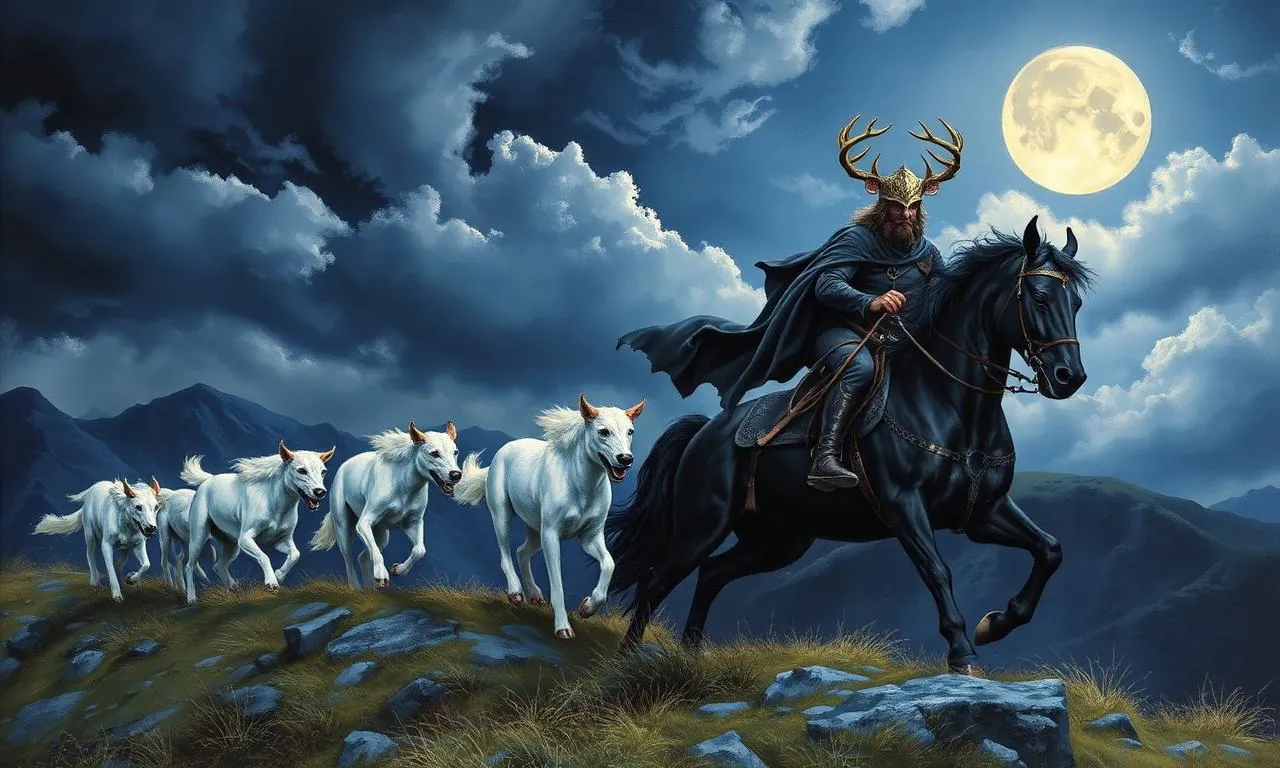
Gwyn ap Nudd — 'White, son of Mist' — is the oldest and most powerful king of Annwn in Welsh tradition. He pre-dates Arawn in the literature, he survives Arawn in the folklore, and he is the figure to whom the Cŵn Annwn — the spectral white hounds with red ears — ultimately belong. Where the Cŵn Annwn ride, Gwyn ap Nudd rides at the head of them.
He appears in Culhwch and Olwen as one of the warriors of Arthur's court, but his role there is unusually serious: God himself, the text says, has placed Gwyn ap Nudd over the demons of Annwn to keep them from destroying the present world. He is not a comic-relief huntsman. He is a containment.
In the dialogue poem Ymddiddan Gwyn ap Nudd a Gwyddno Garanhir, he names himself plainly. He was at the death of Gwendoleu in the battle of Arfderydd. He was at the death of Bran. He was at the death of Llacheu son of Arthur. He stands wherever brave men fall, and he gathers their souls. He is, more or less openly, a psychopomp — a guide of the dead.
The folk tradition that grew up around him is even darker. Gwyn ap Nudd is the king who rides on the longest nights of the year, leading the Cŵn Annwn across the high places of Wales and the west of England, hunting the souls of the unrighteous. He is associated above all with Glastonbury Tor in Somerset — the great green hill where, according to a famous twelfth-century vita, the Christian Saint Collen climbed up to confront him in his invisible palace inside the Tor, found Gwyn enthroned in splendour, and dispersed the whole otherworld court with a flask of holy water. The Welsh tradition has always found that story funnier than the Latin one intended.
Some of the later folklore gives him an antlered crown, like Herne the Hunter; some gives him a black horse and a horn; some gives him a face no living human can look on. The constant elements across the centuries are these: he is the king who hunts on winter nights, he commands the white red-eared hounds, he gathers the dead, and he is older than anything Christian in these isles.
He is also — and this is rarely said — fair. The Welsh poems never call him cruel. He takes the souls he is owed. He does not take the ones he is not. He is the original lord of the wild hunt in these islands, and every later version, from Herne the Hunter to the Wild Hunt of European Romanticism, is downstream of him.
Wear something inspired by Gwyn ap Nudd and you wear the oldest king of Annwn — the rider on the longest night, the master of the Cŵn Annwn, and the quiet figure who is said to be sitting, even now, somewhere inside the green hill at Glastonbury, waiting for winter.