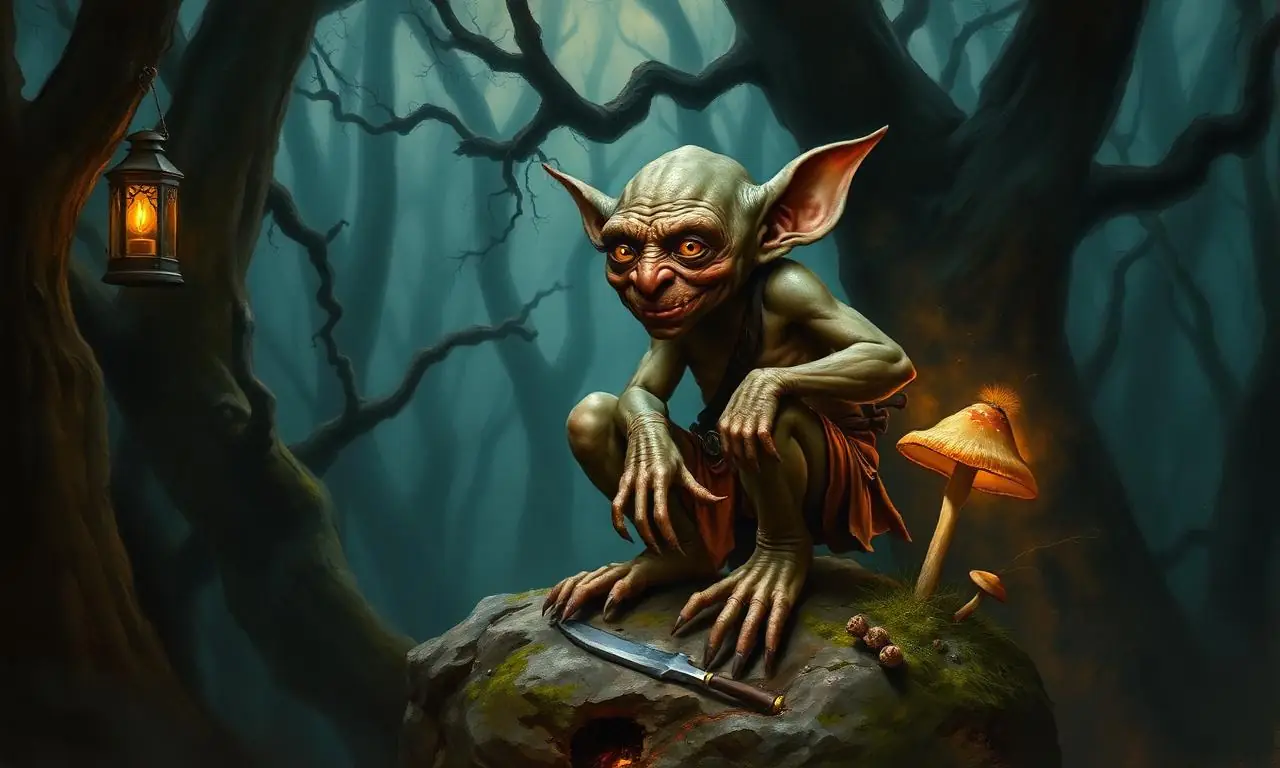
The goblin is one of the oldest and most slippery creatures in European folklore. The word itself comes by a winding road from the Old French gobelin, which in turn descends from the Latin gobelinus and probably from the Greek kobalos — a kind of mischievous trickster spirit known to the ancient world. Wherever the word travelled, the creature travelled with it: small, sharp-toothed, sharp-witted, and almost never to be trusted.
Medieval England knew the goblin well. He was the spirit who soured milk left out overnight, who tangled the manes of horses in the field, who stole small bright things and hid them in the rafters. Some were household pests, no worse than a rude cat. Others — the boggarts of Lancashire, the redcaps of the Border country, the hobgoblins of the deep woods — were genuinely dangerous, and a wise farmhand kept iron nails in his pocket and a mouthful of prayers handy.
In Welsh tradition the goblin's closest relatives are the coblynau — the knockers of the slate quarries and copper mines of Eryri (Snowdonia) and Anglesey. About a foot and a half tall, dressed in tiny miner's clothes, they were said to lead miners to the richest seams by tapping on the rock with their little hammers. Treat them well, leave them a corner of your bread and cheese, and they would knock you toward fortune. Mock them, swear in the workings, or refuse to share, and they would tap you straight into a cave-in.
German folklore has its kobolds; Cornish mining tradition has its knockers and buccas; Scottish tradition has its bogles. All of them belong to the same family — the small, hidden, easily offended people who live in the hollow places of the world and judge the manners of those who pass through.
The goblin became truly monstrous in the literary imagination only later. Christina Rossetti's poem Goblin Market (1862) gave him his predatory edge — the long-fingered fruit-seller luring young women into ruin. George MacDonald's The Princess and the Goblin (1872) sent him underground as an enemy of all surface-dwellers. Tolkien borrowed both visions for The Hobbit, made the goblins of the Misty Mountains genuinely murderous, and from Tolkien the figure passed into half a century of fantasy gaming, films and now video games.
Strip away the orcish armour and you are left with the original: a small, hidden creature, easily offended, easily made an ally, and never quite a friend. Wear the goblin and you wear the older European warning — leave the milk out, mind your manners, and never insult the people you cannot see.