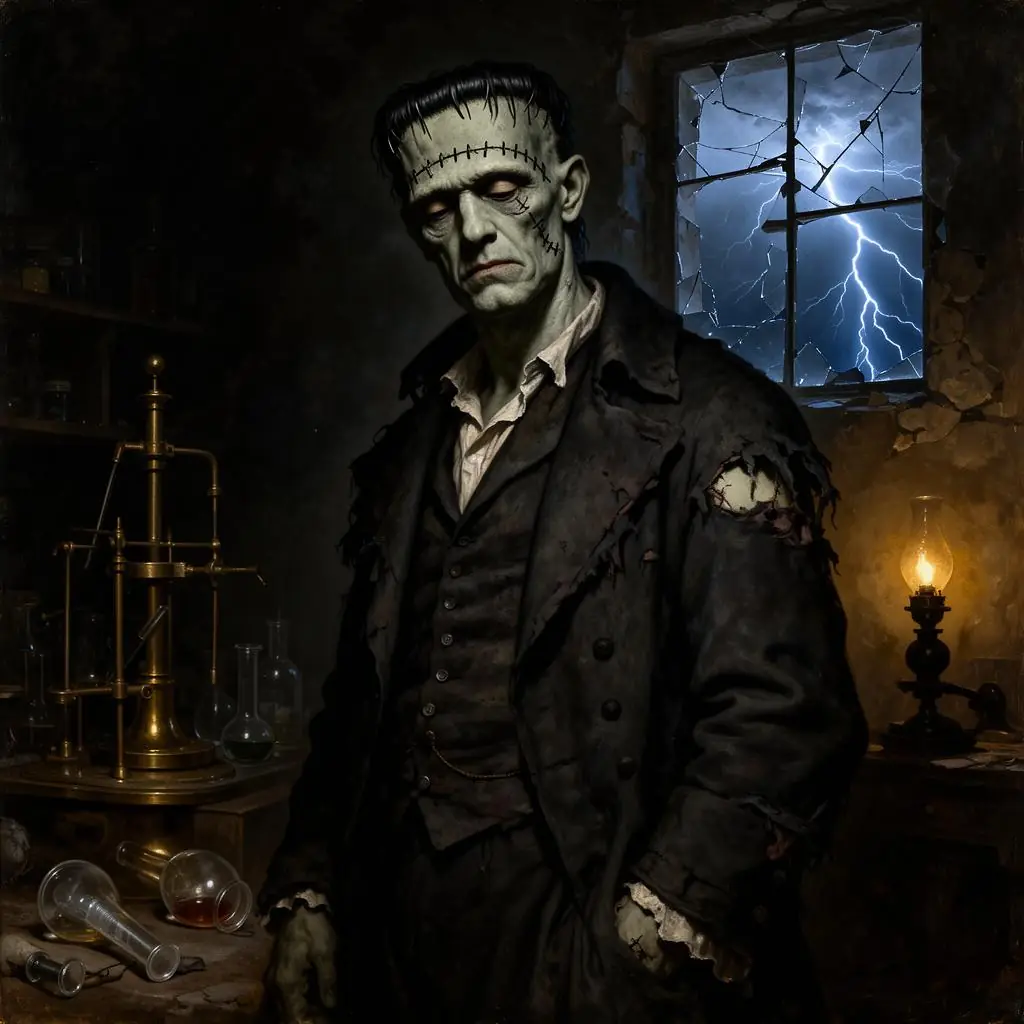
He has no name of his own. Two hundred years after Mary Shelley wrote him into being, we still call him by the surname of the man who made him and abandoned him — Frankenstein. The Monster. The Creature. The Modern Prometheus. Every label belongs to someone else. He has only ever been allowed to be a noun.
Shelley was eighteen when she dreamed him, on a wet summer at the Villa Diodati on Lake Geneva in 1816, during the long competition with Byron and Percy Shelley to write the best ghost story. The novel she finished — Frankenstein, or The Modern Prometheus — was published anonymously in 1818, and is now widely cited as the first true work of science fiction. A young scientist, Victor Frankenstein, learns the secret of animating dead tissue. He builds a man from grave-robbed parts, brings him to life on a stormy night in his attic laboratory, and then — appalled by what he has done — runs out of the room and leaves his creation alone.
Everything that follows is the Creature's slow education in what humans are. He teaches himself to read, in secret, by listening at the wall of a cottage. He saves a drowning girl and is shot for it. He asks his maker for a single companion of his own kind, and is refused. Only then — only after every door in the world has been closed — does he turn dangerous. Shelley's argument is unmistakable: the monster was not born monstrous. He was made monstrous by being unloved.
That is why the modern reading insists on calling him a hero, not a villain. He is the patron saint of every outsider who has been told they are too strange, too tall, too stitched-together, too much. Boris Karloff's flat-headed 1931 portrayal made him an icon; the Hammer films made him a horror; the original novel makes him a tragic philosopher with better grammar than most of the people who fear him.
Wear Franken Hero and you wear the original Modern Prometheus — the proof that intelligence, sorrow and a longing to be loved can all live inside a body that the world insists on calling monstrous.