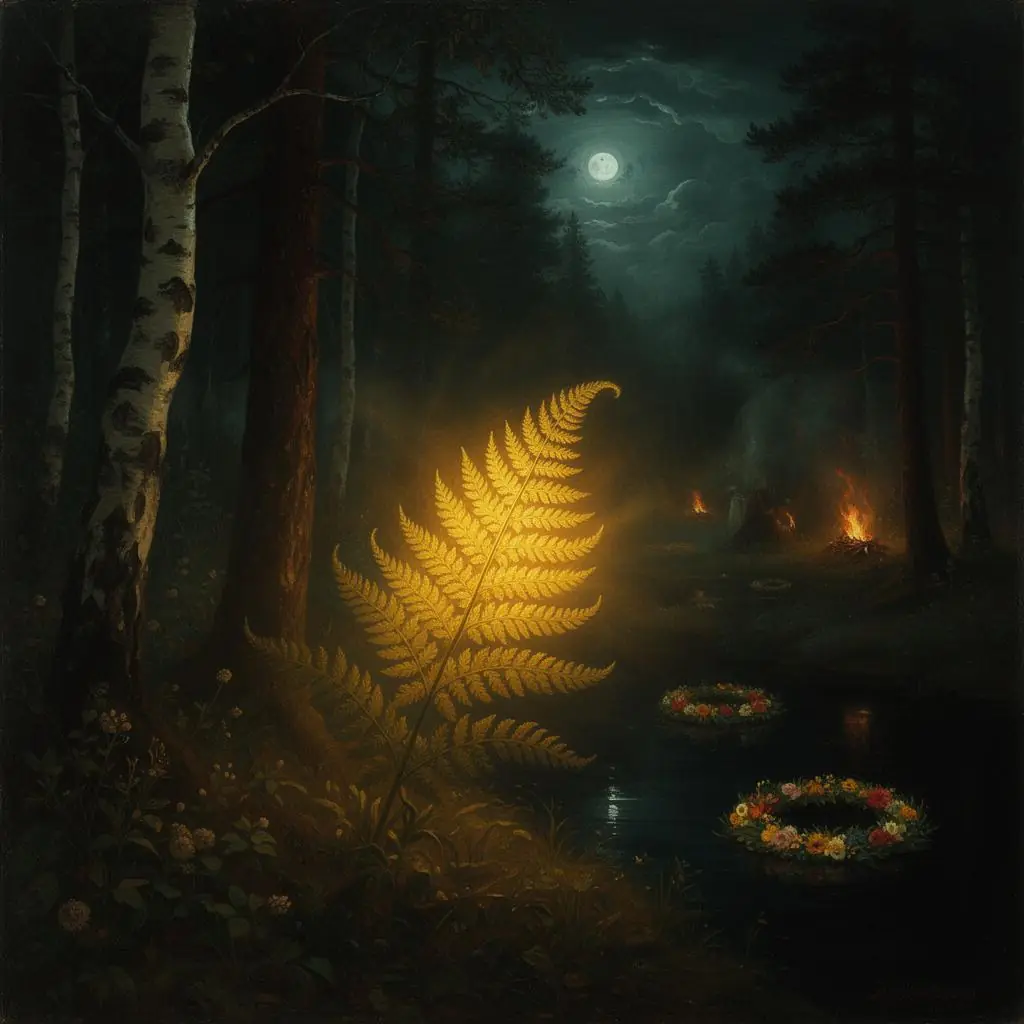
Ferns do not flower. Every botanist knows it. Every Slavic grandmother knows it too — and tells the story anyway, because the Fern Flower is not really about botany. It is about the one night a year when the rules of the world go quietly soft.
The legend belongs to Kupala Night — the midsummer festival celebrated across Poland, Ukraine, Belarus, Russia and the wider Slavic world on the shortest night of the year. Fires are lit on the riverbanks, young women weave wreaths of wildflowers and float them down the water by candlelight, and somewhere out beyond the firelight, in the deepest part of the forest, a single fern is said to bloom for one heartbeat at midnight.
The flower is described as a small, impossibly bright golden-amber blossom that glows like a held coal. Whoever finds it is granted understanding of the speech of animals, the location of every buried treasure in the land, and the ability to read the hidden hearts of other people. The catch — and there is always a catch in Slavic folklore — is that the forest does not want it found. Spirits, leshys and forest devils crowd the seeker, whisper their name from the trees, and try to make them look back. One backward glance and the flower is lost.
Some versions are darker. In a few Polish and Ukrainian tellings the Fern Flower can only be claimed by selling your soul, or by walking out of the forest having abandoned the person you walked in with. The gift is real. The price is always more than it looked.
Wear the Fern Flower and you wear the most hopeful and most haunted of Slavic legends — the one night a year when the forest opens, the one bloom that should not exist, and the old, quiet warning that some gifts are heavier than the people who carry them home.