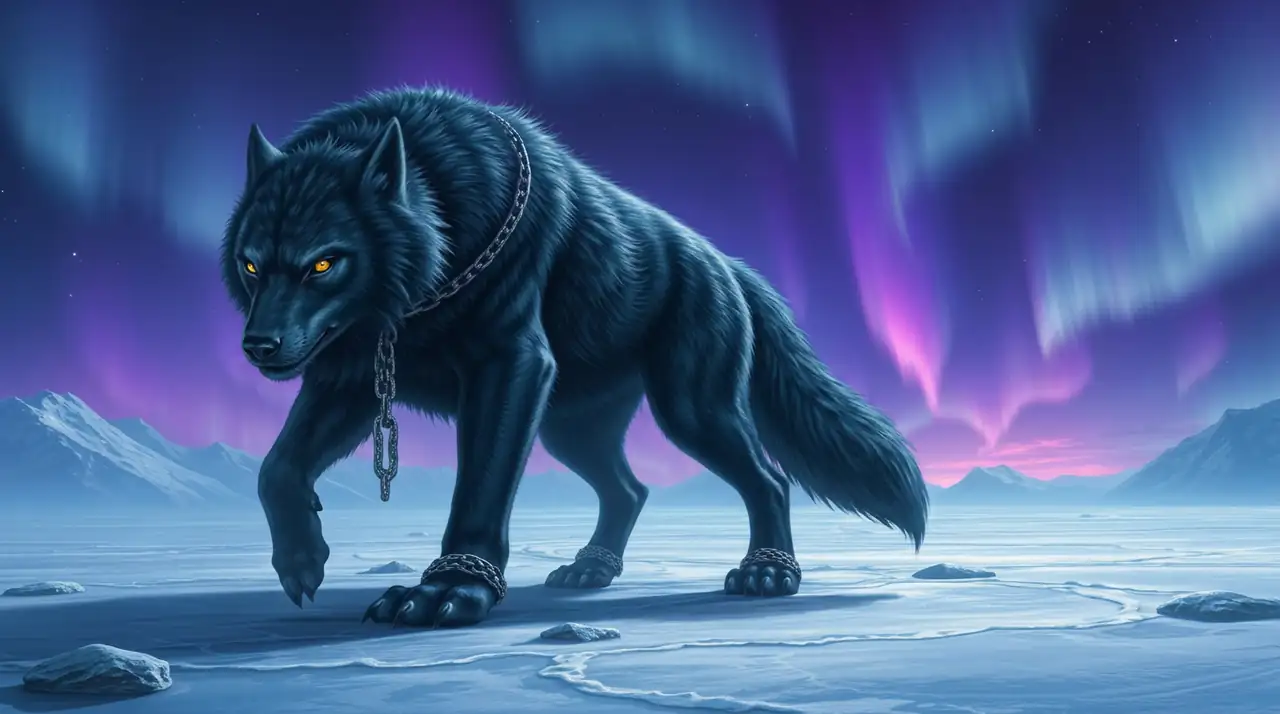
Of all the prophecies in Norse myth, the one about Fenrir is the cruellest, because the gods knew. They saw it coming from the day Loki's son the wolf-cub was carried into Asgard, and they raised him anyway — because what else can you do with a thing you fear and cannot kill?
Only Týr was brave enough to feed him. The wolf grew fast. Too fast. Soon he was bigger than any beast the gods had ever made, and the prophecy was clear: at Ragnarök, Fenrir would break loose, swallow Odin whole, and end the world of the gods. So they decided to bind him.
Twice they tried with iron chains, and twice Fenrir snapped them as a joke. The dwarves were sent for. They forged Gleipnir — a ribbon as soft as silk, made from impossible things: the sound of a cat's footstep, the breath of a fish, the roots of a mountain, the spittle of a bird. Fenrir, suspicious, agreed to be bound only if one of the gods would put a hand in his mouth as a hostage of good faith.
Týr did it. Knowing exactly what would happen.
When Fenrir realised the ribbon would not break, he closed his jaws. Týr lost his hand. Fenrir was bound to a rock at the bottom of the world, with a sword wedged in his mouth so he could not bite, and a river of saliva pouring from him forever — the river the Norse called Ván, which means 'expectation'.
Because that is the point of Fenrir. He is what we know is coming. Every culture has a wolf at the door. The Norse just had the courage to name him, raise him, and admit that the chains were temporary.
Wear Fenrir and you wear the Viking truth — the world ends, the gods die, the wolf gets loose. And we live well anyway.