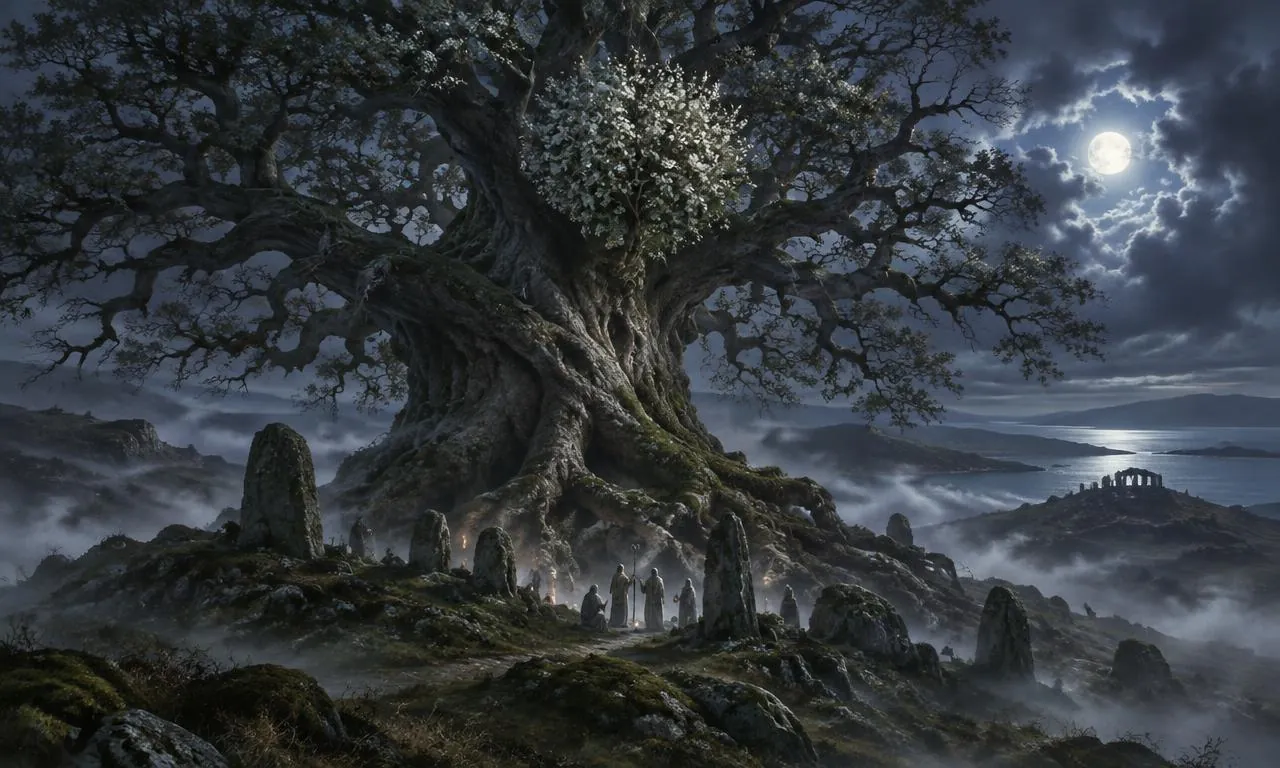
Derwen is simply the Welsh word for an oak tree. Say it slowly and you can hear an older word underneath — the root that gives us 'derw', oak, and, some scholars argue, the very name 'druid': those who know the oak. Some scholars argue that the word druid is related to the same oak-root; it is a guess, not a settled fact.
For the peoples of Iron Age Britain, the oak was not scenery. It was the tallest, oldest, strongest living thing most people would ever stand beside. It drew lightning more than any other tree. It lived for centuries, outlasting kings and families and whole ways of life. It seemed to reach down as far as it reached up — roots in the dark earth, crown among the stars — and so it became a pillar between worlds.
Celtic art is full of that idea: the tree whose branches and roots mirror one another, knotted into a single endless line. Above is the living world. Below is Annwn, the Welsh otherworld, the deep country of the dead and the undying. The oak is where the two meet. Veiled, because you only ever see half of it; the other half grows downwards, out of sight.
The Roman writer Pliny left us the most famous glimpse of druidic ritual. On the sixth day of the moon, he wrote, the druids climbed a sacred oak in white robes and cut the mistletoe with a golden sickle, catching it in a white cloak so that it never touched the ground. Two white bulls were then sacrificed beneath the branches. Mistletoe growing on oak was rare, and so it was precious: a green, living thing that flourished in midwinter, high up, rooted in nothing but the tree itself.
Whatever the exact rites were, the principle was clear. You did not simply fell an oak. The tree was a presence, and cutting it — or taking anything from it — was a matter for ceremony, permission and care.
Which is what makes the story of Ynys Môn so painful. In AD 60 the Roman governor Suetonius Paulinus crossed the Menai Strait to destroy the island that was the druids' last great stronghold. Tacitus describes the scene on the far shore: armed warriors, women in black running between them with torches like Furies, and druids raising their hands to the sky and calling down curses. The soldiers froze — and then came on. The groves of Môn were cut down and burned, and the altars with them.
The groves are gone, but the land remembers. Bryn Celli Ddu still aligns with the midsummer sunrise. Offerings still turned up, two thousand years later, in the peat at Llyn Cerrig Bach. And the Green Man still peers out of the oak leaves carved into church roofs across Wales, as if the old tree simply moved indoors and waited.
Wear Derwen and you wear the tree that held the world together: patient, rooted, older than any empire that tried to burn it.