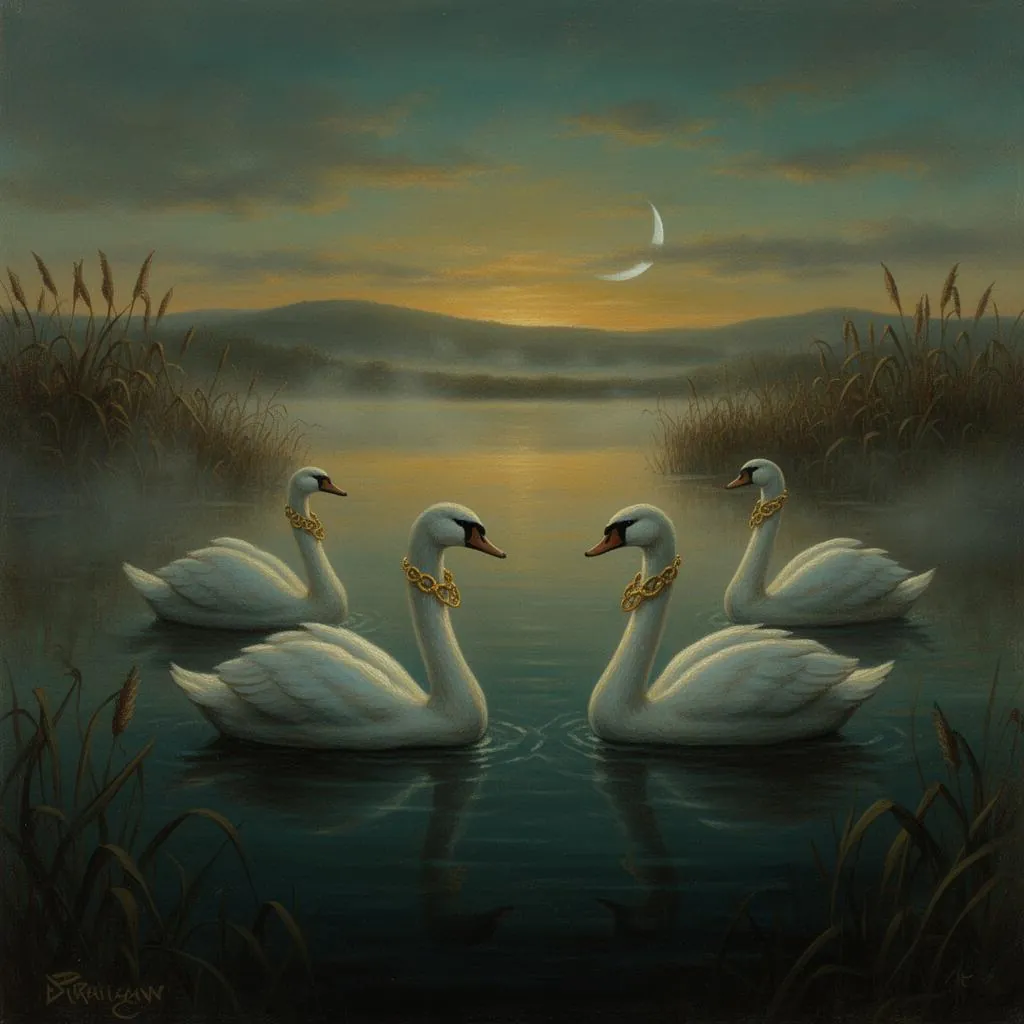
The story of the Children of Lir — Oidheadh Chlainne Lir, 'the Tragic Fate of the Children of Lir' — is one of the Three Sorrows of Storytelling in Irish tradition, and probably the most loved tale on the whole island. It belongs to the Mythological Cycle, the oldest layer of Irish myth, when the Tuatha Dé Danann still walked the land openly.
Lir was a lord of the Tuatha Dé Danann. He married Aoibh, daughter of Bodb Dearg, and they had four children: Fionnuala the eldest, Aodh, and the twins Fiachra and Conn. Aoibh died bringing the twins into the world, and Lir's grief was so great that Bodb Dearg gave him a second wife — Aoibh's own sister, Aoife — to comfort him.
Aoife came to hate the children. They were beautiful, their father adored them, and their grandfather Bodb Dearg sent for them constantly. Slowly the jealousy turned poisonous. One day she took them in a chariot to Lake Derravaragh in Westmeath, and when she had them out on the water she struck them with a druid's wand and turned them into four white swans.
She left them one mercy. They kept their human voices, their human minds, and their gift for singing — and they kept it for nine hundred years. Three hundred years on Lake Derravaragh. Three hundred years on the wild strait of the Sea of Moyle between Ireland and Scotland, where the cold nearly killed them. Three hundred years on the bleak Atlantic at Iorras Domhnann.
Lir found them. He came to the shore of Derravaragh and heard their singing and recognised his daughter's voice. He could not break the curse — only the marriage of a southern prince to a northern princess, and the ringing of a Christian bell over Ireland, could end it — but he kept his court on the lakeshore for as long as the swans were there, and so did everyone who heard them sing. For three hundred years the most powerful family in the Tuatha Dé Danann lived on the bank of a lake to listen to four singing swans.
When the nine hundred years ended the spell broke on the western shore. The four swans crumbled into four impossibly old human figures — three withered men and one withered woman — and the monk Mochaomhóg, who had taken them in and rung the first bell over them, baptised them at the moment of their death. They were buried together as Fionnuala had asked, with Conn at her right shoulder, Fiachra at her left, and Aodh in front of her, the way she had sheltered her brothers under her wings on the worst nights of the Sea of Moyle.
By the time the spell broke, the Tuatha Dé Danann were gone. Ireland had become a Christian country. The children of Lir had outlived their own gods.
Wear something inspired by the Children of Lir and you wear the gentlest and most heartbreaking story Ireland tells — four white swans on a still lake at evening, singing in human voices that have been singing for nine hundred years.