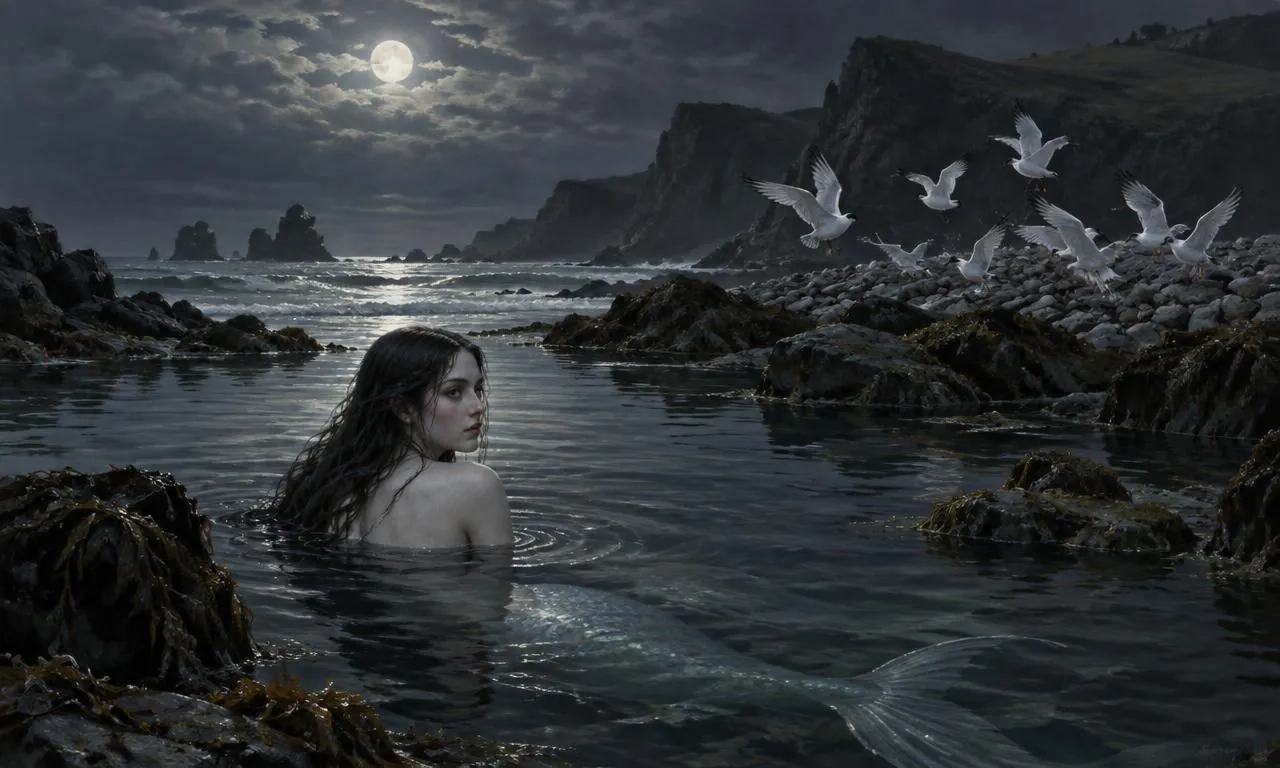
The north coast of Ynys Môn is a different island. Gone are the gentle sands of the south and east; here the land breaks into black rock, heather and wind, and the sea runs hard around the headlands. At Cemlyn, a long curving ridge of shingle — Esgair Gemlyn — holds back the waves from a still, brackish lagoon. On one side, the tide-race. On the other, water like glass.
In summer the lagoon's little islands are loud with terns: Sandwich, Arctic and common terns that come thousands of miles to nest here, rising in white clouds whenever anything startles them. Birdwatchers come for them. The old fishermen of the north coast said you should watch the terns for another reason. When they all lifted at once, for no reason you could see, something had come up in the lagoon.
That something was the môr-forwyn — the sea-maiden. Welsh coasts are full of them, from the mermaid who sang to the sailors off Cardigan to the sirens heard below South Stack, a few miles west of Cemlyn. The Cemlyn mermaid, as the tellings go, belonged to the north shore: seen in the lagoon on still evenings, combing her hair on the shingle ridge, or glimpsed as a pale arm raised in the tide-race just offshore.
She was not always a danger. In some versions she is a warning spirit: a fisherman who saw her at dusk knew to haul in his nets, turn his boat, and make for home, because a storm was coming. Men who heeded her came back. Men who laughed and stayed out did not. In others, she is lonelier and stranger — a woman of the sea who could not leave the lagoon when the tide dropped, trapped between two waters, watching the lights of the farms up the hill.
Welsh sea-folk tales share a hard kind of courtesy. The sea gives, and the sea takes, and the people who live beside it do well to keep an eye on its moods. A mermaid is that idea with a face. She is beautiful because the sea is beautiful, and she is dangerous for the same reason. You do not own her. You pay attention.
North Anglesey has always needed that attention. Its coast is one of the most treacherous in Wales, strewn with wrecks from the Skerries to Carmel Head; the lifeboat was established at Cemaes nearby for good reason. Every family on this shore had someone who went out and did not come home. It is no surprise that they saw a pale figure in the water, and wondered whether she had been trying to tell them something.
Wear the Mermaid of Cemlyn and you carry the north coast with you: salt wind, white terns, and a still lagoon where something is always, very quietly, watching.