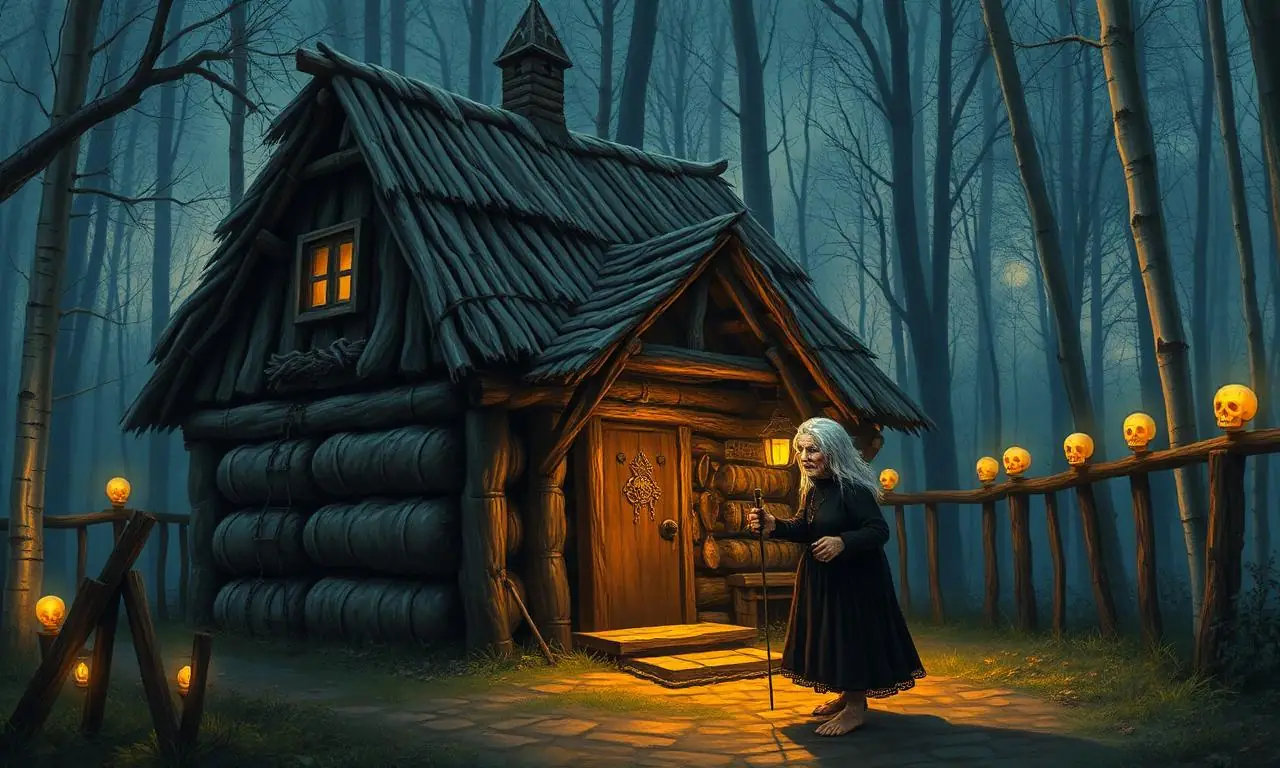
Across the Slavic world — Russian, Ukrainian, Belarusian, Polish, Czech — every grandmother who ever wanted a misbehaving child to sit still has reached for the same name. Baba Yaga. Grandmother Witch. The one who lives at the edge of the dark forest in a wooden hut that walks on enormous chicken legs, surrounded by a fence of human bones topped with skulls whose eyes glow at night.
She is not simply a villain. That is the part folklorists keep insisting on. Baba Yaga can eat you, yes — she has iron teeth and a mortar she rides through the sky like a boat, sweeping her tracks behind her with a silver birch broom. But she can also save you. In dozens of Russian wonder tales — Vasilisa the Beautiful, the Frog Princess, Marya Morevna — the hero is sent to her hut expecting death, and instead receives the one impossible gift that solves the story.
The rule is always the same. She tests you. If you arrive demanding, she devours you. If you arrive polite — if you greet her properly, work for your supper, treat her servants kindly, and answer only the questions she asks — she may give you fire in a skull, or a magical doll, or directions through the trackless forest. She is the ancient Slavic embodiment of the truth that the wild does not love or hate you. It only responds to how you behave inside it.
The chicken-legged hut, the mortar, the iron teeth — these are not decoration. They are signs that you have left ordinary geography. Her house turns its back to the forest and its front to whoever knows the words. Her fence is made of the bones of those who did not know them.
Wear Baba Yaga and you wear the oldest Slavic teaching — that the witch at the edge of the woods is not your enemy and not your friend. She is your mirror.