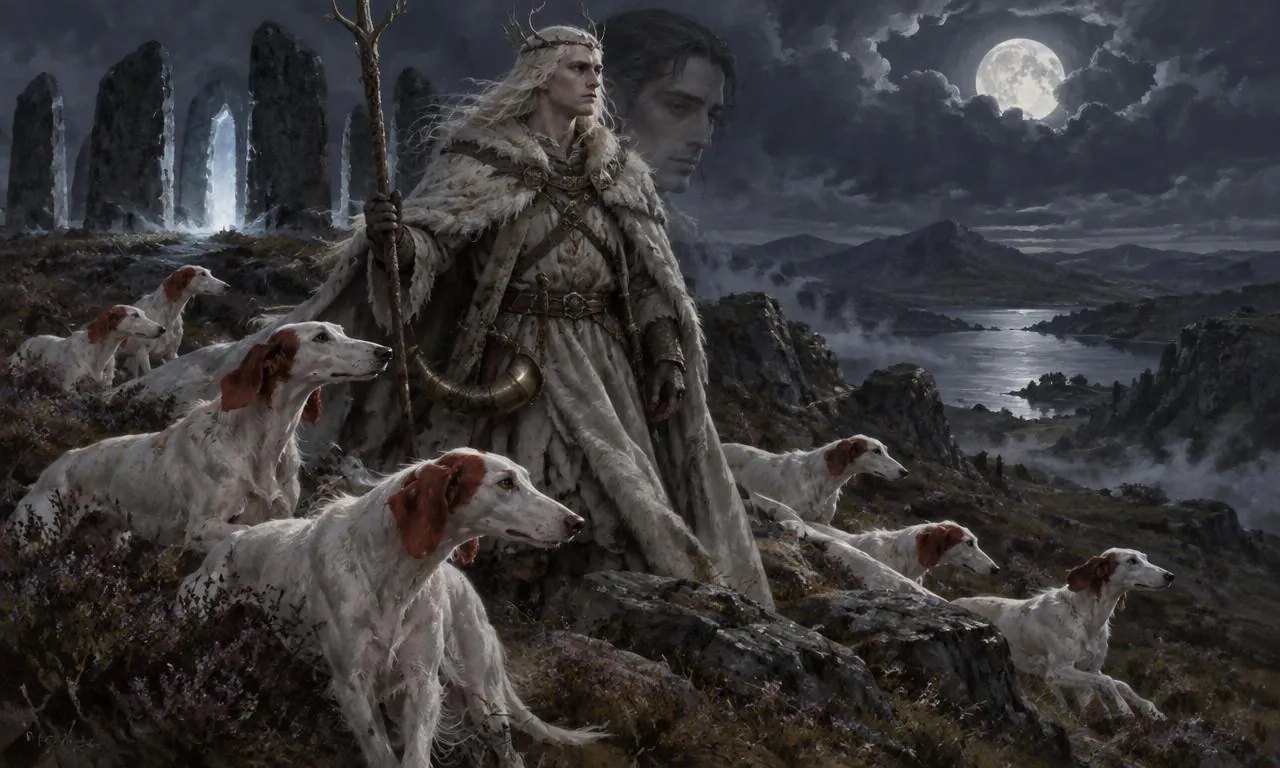
The Mabinogi opens not with a battle or a birth, but with a mistake. Pwyll, Prince of Dyfed, is out hunting in Glyn Cuch when he loses his companions and hears another pack running through the woods. Into a clearing bursts a stag, and after it come hounds unlike any he has seen: shining white, with ears as red as blood.
They bring the stag down. Pwyll, being young and a prince, drives them off and sets his own dogs on the kill. It is a small discourtesy in the world of men. In the world he has just stumbled into, it is an insult to a king.
A rider comes out of the trees on a great grey horse, dressed in grey hunting clothes, a horn around his neck. He does not shout. He simply tells Pwyll that he has never seen such rudeness from one man to another, and names himself: Arawn, king of Annwn.
Annwn is the Welsh otherworld — not a hell, and Arawn no devil. It is a kingdom of feasting halls and beautiful people and endless courtesy, lying just beside our own. Its king is proud, fair, and entirely unamused.
Pwyll asks how he can make amends, and Arawn names his price. There is another king in Annwn, Hafgan, who wars against him every year. Pwyll will take Arawn's face and form and rule in his place for a year and a day. At the end of it, he will meet Hafgan at the ford — and he must strike him only once. A second blow, Arawn warns, will restore him as if nothing had happened.
So the two men exchange faces. Pwyll rides into Annwn as its king. No one there knows the difference, not the stewards, not the nobles, not even Arawn's wife, the most beautiful woman Pwyll has ever seen. And here is the quiet heart of the tale: every night for a year, Pwyll lies beside her and turns his face to the wall, and never once touches her. He will wear another man's crown, but not take what is his.
When the year turns, he meets Hafgan at the ford. One blow splits Hafgan's shield and throws him from his horse. 'For God's sake,' Hafgan begs, 'finish me.' Pwyll refuses. He has been told the rule, and he keeps it. Hafgan's men carry him off to die, and the two kingdoms of Annwn become one.
Arawn returns to his own court to find it ruled better than he left it — and when his wife mentions, puzzled, that he has not spoken to her in bed for a year, he realises exactly what kind of friend he has found. The two kings exchange faces back, and from that day they are sworn allies, trading hounds, horses and hawks across the veil. Pwyll is known ever after as Pen Annwn: Head of the Otherworld.
The red-eared hounds still run through Welsh folklore as the Cŵn Annwn, the Wild Hunt. But Arawn himself is remembered for something rarer than terror. He is the king who asked for justice, not revenge — and found honour in the one place he least expected it: a mortal wearing his face.