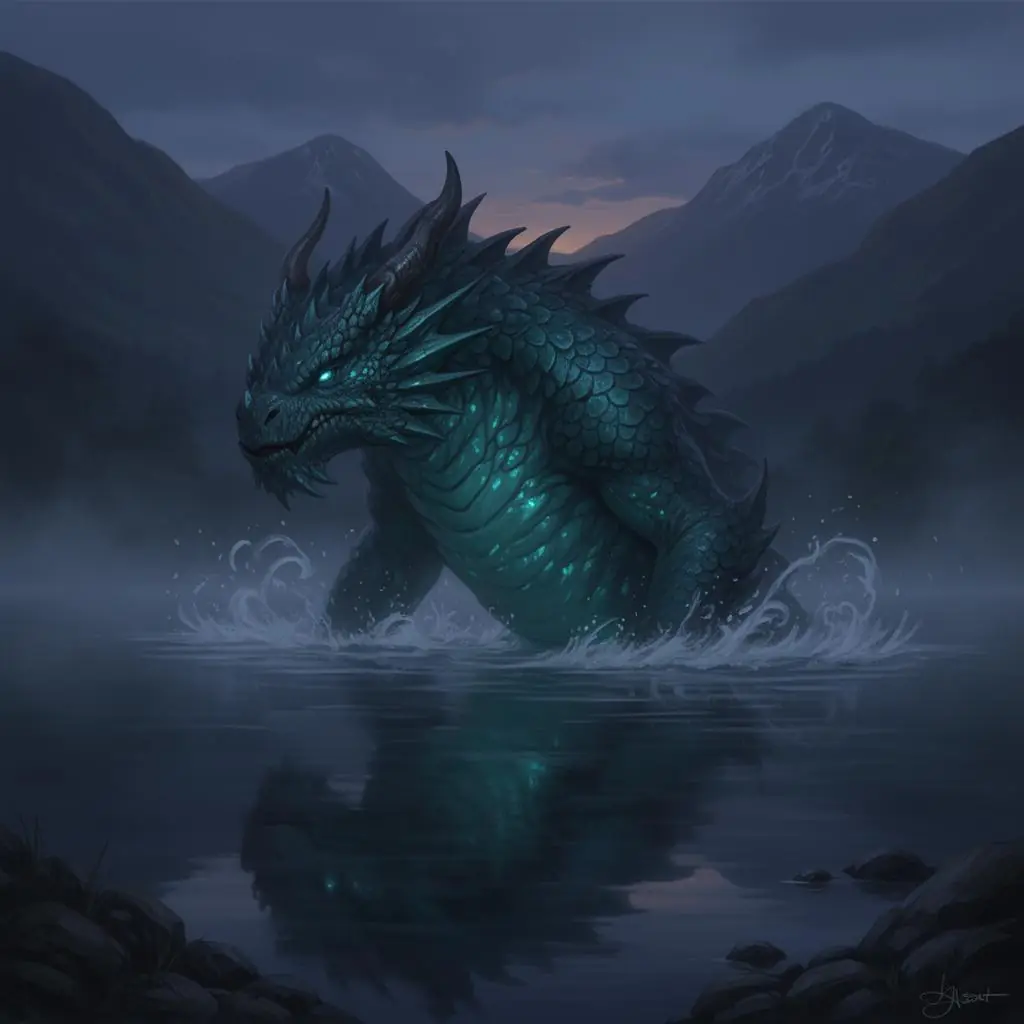
There are old pools in Wales that the locals will still tell you not to swim in. Llyn yr Afanc on the Conwy. Llyn Barfog above Aberdyfi. Llyn Llion, somewhere lost in the mountains. The reason, in every case, is the same: the Afanc.
The Afanc is one of the strangest creatures in Welsh mythology because no two storytellers ever quite agreed on what it looked like. Some described a monstrous beaver, larger than an ox. Some a crocodile. Some a dwarf, some a demon, and most often something dragon-like — scaled, clawed, and old as the lakes themselves.
What everyone agreed on was its appetite. The Afanc dragged the unwary down into the depths. It thrashed the water into floods that drowned whole valleys. In one telling, it caused the Deluge that nearly wiped out the world, and only Hu Gadarn — with his great oxen — was able to haul it from the lake and chain it elsewhere.
The most famous Welsh telling places it in Llyn yr Afanc on the Conwy river. The villagers, desperate, tricked the beast: a beautiful maiden lured it into resting its head on her lap, and while it slept, they bound it in iron chains. Hu Gadarn's oxen then dragged it up over the mountains to Llyn Cwm Ffynnon, where some say it still lies, sulking and immortal, beneath the still water.
The Afanc endures because it taps into something very old in these isles — the suspicion that our deepest, blackest lakes are not empty. That the water remembers. And that something down there is patient.
Stand on the shore of any glacial Welsh lake at dusk, watch the surface go perfectly still, and you will understand exactly why this story refuses to die.