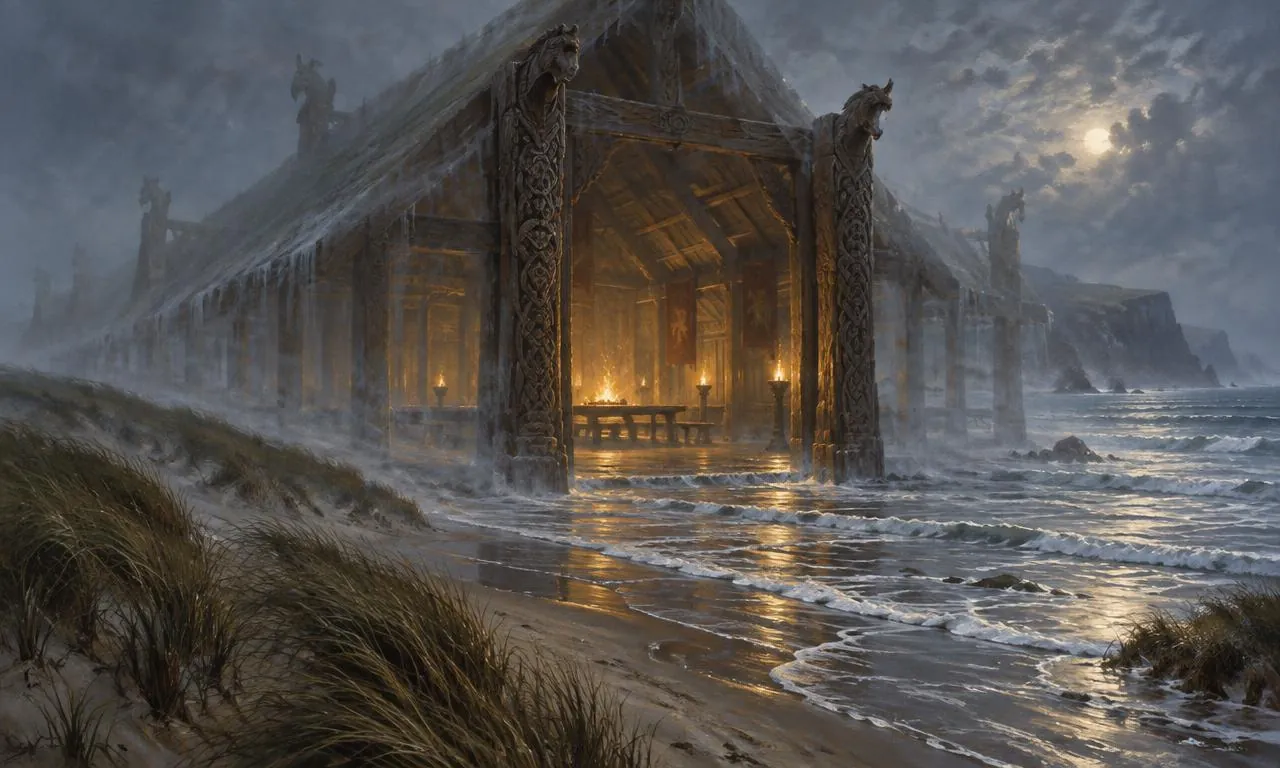
Aberffraw today is a small, pretty village of grey houses, an old humpbacked bridge over the Ffraw, and a vast stretch of dunes rolling down to the sea. You could drive through in a minute. Yet for centuries this was one of the most important places in Wales: the royal court, the llys, of the kings and princes of Gwynedd.
Gwynedd was the great northern kingdom, and Ynys Môn was its larder — Môn Mam Cymru, Anglesey the mother of Wales, whose corn could feed the mountains. The kings who held the island held the kingdom, and Aberffraw was where they kept their hall. The medieval Welsh laws name it as one of the three chief courts of Wales, and its rulers took the title with pride. Llywelyn ab Iorwerth, Llywelyn the Great, styled himself 'Prince of Aberffraw and Lord of Eryri' — the island court first, the mountains second.
The llys would have been a timber hall, long and high-roofed, its posts carved and painted, a fire running down the middle. Here the king's household gathered: the bard to sing his praises, the judge, the chief huntsman, the doorkeeper, the steward. Here the princes feasted, gave judgement, received messengers and planned their wars against the Normans and the English kings across the border.
Aberffraw was royal in story long before it was royal in record. In the Second Branch of the Mabinogi, it is at Aberffraw that Bendigeidfran, giant king of the Island of the Mighty, receives Matholwch of Ireland and gives him his sister Branwen as a bride. The wedding feast is held here, in tents, because no house could hold Bendigeidfran. And it is here that Efnysien, furious at not being asked, mutilates the Irish king's horses — the insult that sets the whole terrible tale of Branwen in motion.
Then the court vanished. After Edward I conquered Gwynedd in 1282, the royal halls lost their purpose. In 1317 the timbers of the llys at Aberffraw were taken down and carried away to repair Caernarfon Castle — the old hall of the Welsh princes quite literally used to patch the fortress built to hold their land. Over the centuries the sand crept in, and the place where the hall had stood slipped out of certain memory. Archaeologists still debate exactly where it was.
Local tradition fills the gap. People say that on misty nights by the dunes you may glimpse torchlight where no building stands, or hear the harp and the hum of a crowded hall under the sound of the sea. A few miles inland lies Llyn Coron, where the Afanc was said to lurk; the old kings would have ridden past it on their way to hunt.
Wear Aberffraw and you wear the memory of a Wales that ruled itself from a hall by the sea on Ynys Môn — quiet now, sand-drifted, and still, if you listen, a little bit royal.