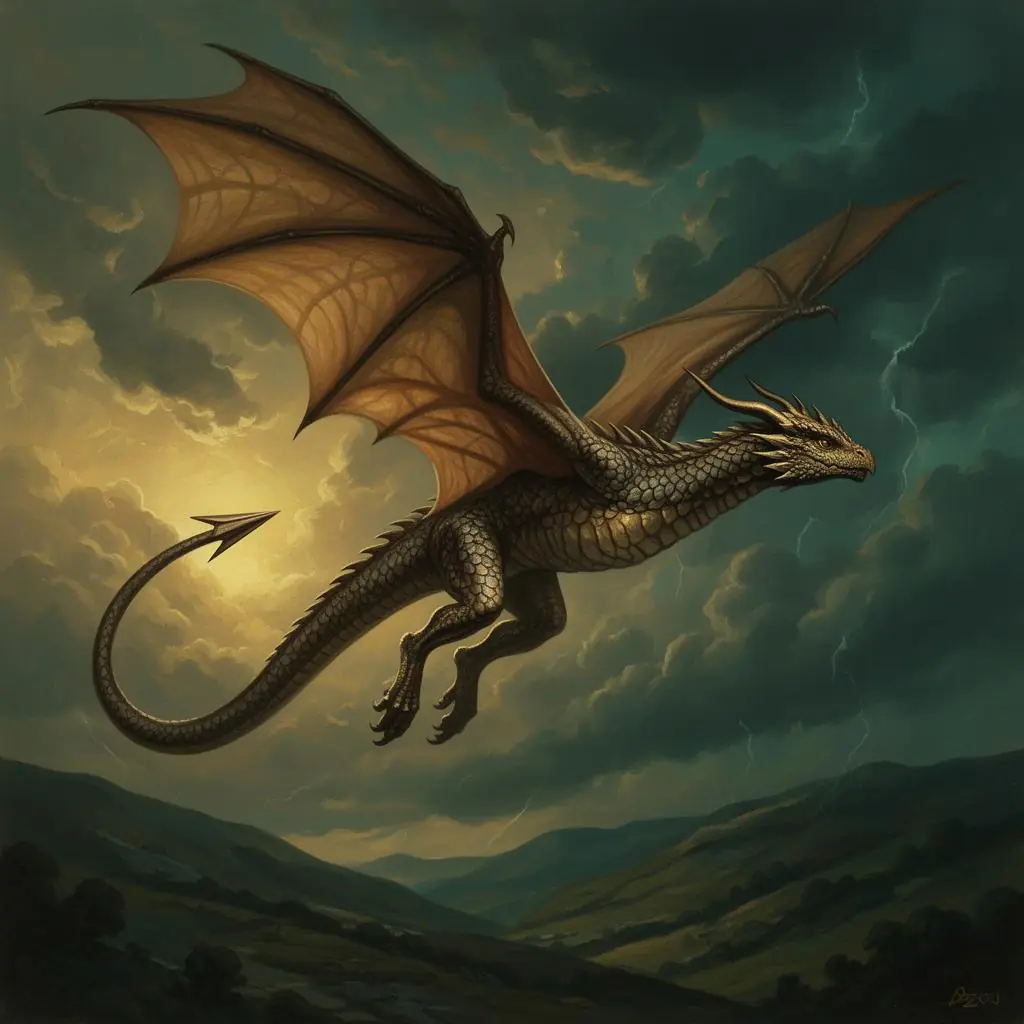
Most people lump every winged reptile in Western myth under the same word: dragon. The medieval heralds were fussier. They drew a strict line between the four-legged dragon proper and its smaller, sharper cousin — the wyvern.
A wyvern walks on two legs, not four. Its wings are its 'arms', leathery and bat-like, attached to powerful shoulders. Its tail is long, often barbed or arrow-tipped, and in some traditions venomous. It is leaner, faster, and meaner than the great heraldic dragon, and it appears on the heraldry of half of medieval Britain — including the personal banner of the kings of Wessex, who marched under a golden wyvern long before the red dragon flew over Wales.
In British folklore, wyverns are the dragons of plague, jealousy, and foul water. They lurk in marshes and well-shafts; they bring poisoned air. The most famous English wyvern story is probably the Mordiford Wyvern of Herefordshire, said to have grown from a small green serpent kept as a pet by a village girl into a full-sized monster that terrorised the parish until a condemned criminal was sent to fight it in exchange for his pardon. He killed it, the legend says — and was killed himself by its dying breath.
Wyverns also appear quietly in Welsh tradition, where they sit alongside Y Ddraig Goch as her smaller, swifter relations. Some folklorists argue that the original 'red dragon' on the Welsh banner was technically a wyvern, two-legged and barbed-tailed, and only became the full four-legged dragon we know today in later medieval art. Look closely at very old Welsh heraldry and you can sometimes see it — only two legs gripping the shield.
The wyvern is, in a sense, the working dragon. Less godlike than its larger cousin, more agile, more grounded in real medieval landscape. It is the dragon that earned its place on shields and tavern signs, on regimental colours and county arms, on the gates of Mordiford and the banners of the West Saxons.
Wear the wyvern and you wear the dragon that medieval Britain actually drew: a little smaller, a little sharper, and a great deal more present in our hills than the storybook version that came after.