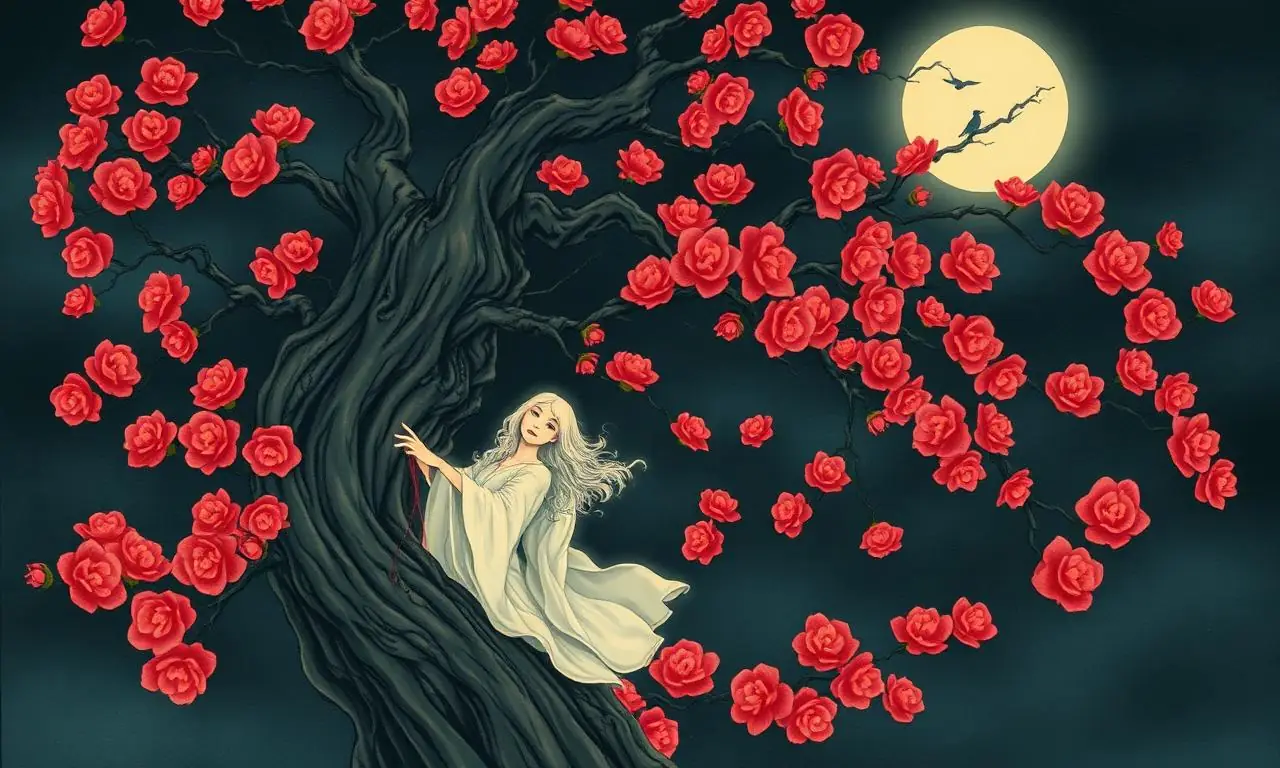
Japanese folklore has a quiet rule about old things. A tool used for a hundred years gains a soul. A house lived in for centuries learns to listen. And a tree — especially a camellia, with its blood-red flowers and its long, long life — eventually wakes up. The Furutsubaki-no-rei, the spirit of the old camellia, is what wakes up.
In Edo-period yokai catalogues, the Furutsubaki appears as a beautiful pale woman wrapped in white robes, her hair loose, her skin almost luminous. She emerges from the trunk of an ancient camellia at night, sometimes carrying a single red blossom, sometimes weeping at the foot of her own tree. She does not always mean harm. Sometimes she simply walks the garden of the temple where her tree was planted, looking for the people she once watched grow up and die.
But the camellia in Japan has always carried a slightly uneasy meaning. Unlike cherry blossoms, which fall petal by petal, the camellia drops its entire flower in one heavy, sudden movement — like a severed head. Samurai considered the tree unlucky for that reason. Old camellias near temples and shrines were treated with a kind of cautious respect, never cut down, sometimes roped off with shimenawa to mark them as the home of a kami.
The Furutsubaki sits in that crack in Japanese feeling — between beauty and unease, between life and the moment a flower falls. She is the soul of an old tree that has seen too much, dressed in the colour of blossom and blood.
Wear the Furutsubaki and you wear the Japanese understanding that something is always alive in the oldest things — and it remembers everyone who passed beneath it.