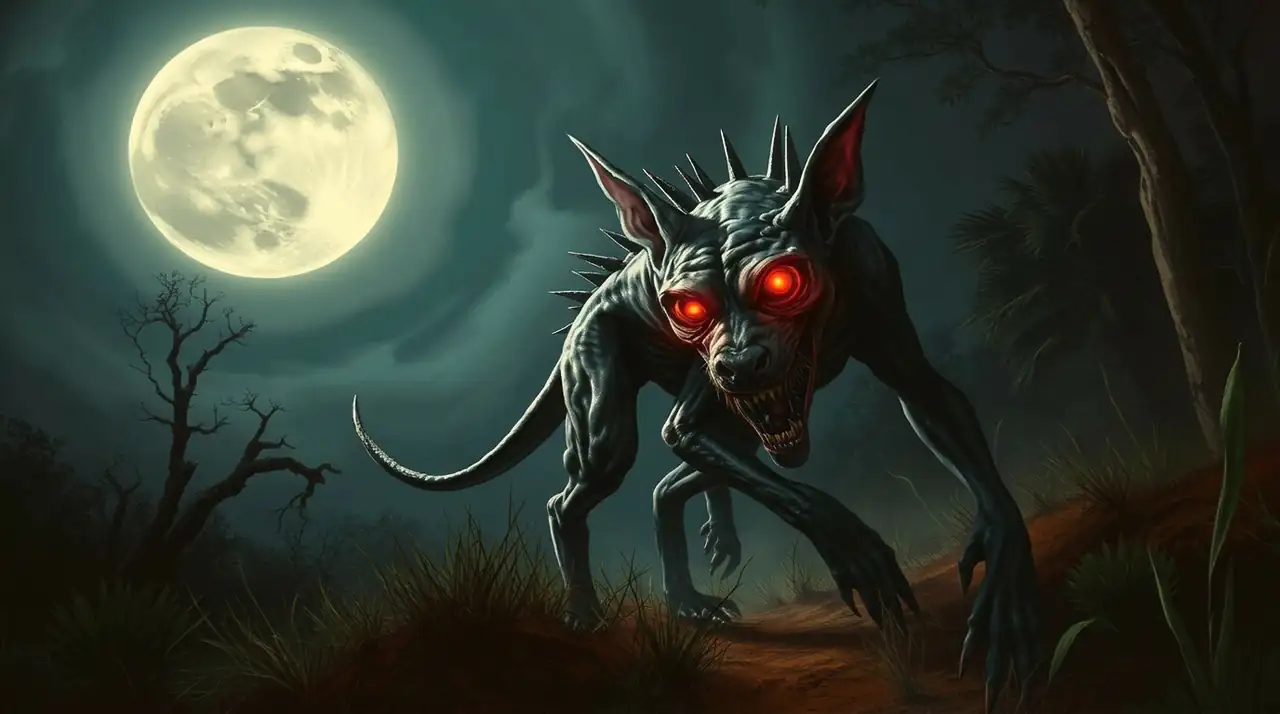
Most monsters are old. The Chupacabra is not. It was born in March 1995 in the town of Moca, Puerto Rico, when farmers woke to find eight sheep dead with three neat puncture wounds in their chests and every drop of blood drained from their bodies. Within months similar killings were reported across the island, then in Mexico, then across the southern United States, then as far as Chile and the Philippines. A new monster had arrived in real time, and the world watched it spread.
The name means 'goat-sucker' in Spanish — chupar (to suck) and cabra (goat) — coined by a Puerto Rican comedian on a radio show. Eyewitnesses described a creature about four feet tall, hairless, grey-green, with a row of sharp spines down its back, long claws, hopping on powerful hind legs, and red eyes that glowed in the dark. Some said it had wings. Others said it hissed. All said it killed silently and left the bodies untouched but bloodless.
Scientists later identified many of the carcasses found in Texas as coyotes suffering from severe sarcoptic mange, which causes hair loss, thickened grey skin and hunger that drives them to attack livestock. But the Puerto Rican original — the spined, bipedal one — has never been explained. Some link it to escaped lab animals. Some to extraterrestrials. Some to the simple human need to give a face to the unseen thing that kills your animals in the dark.
What makes the Chupacabra special is that it is a folk monster we watched being made. No medieval manuscript. No oral tradition stretching back centuries. Just terrified farmers, a clever name, and a story that crossed the Caribbean and the Americas faster than any monster before it.
Wear the Chupacabra and you wear the newest old myth in the world.