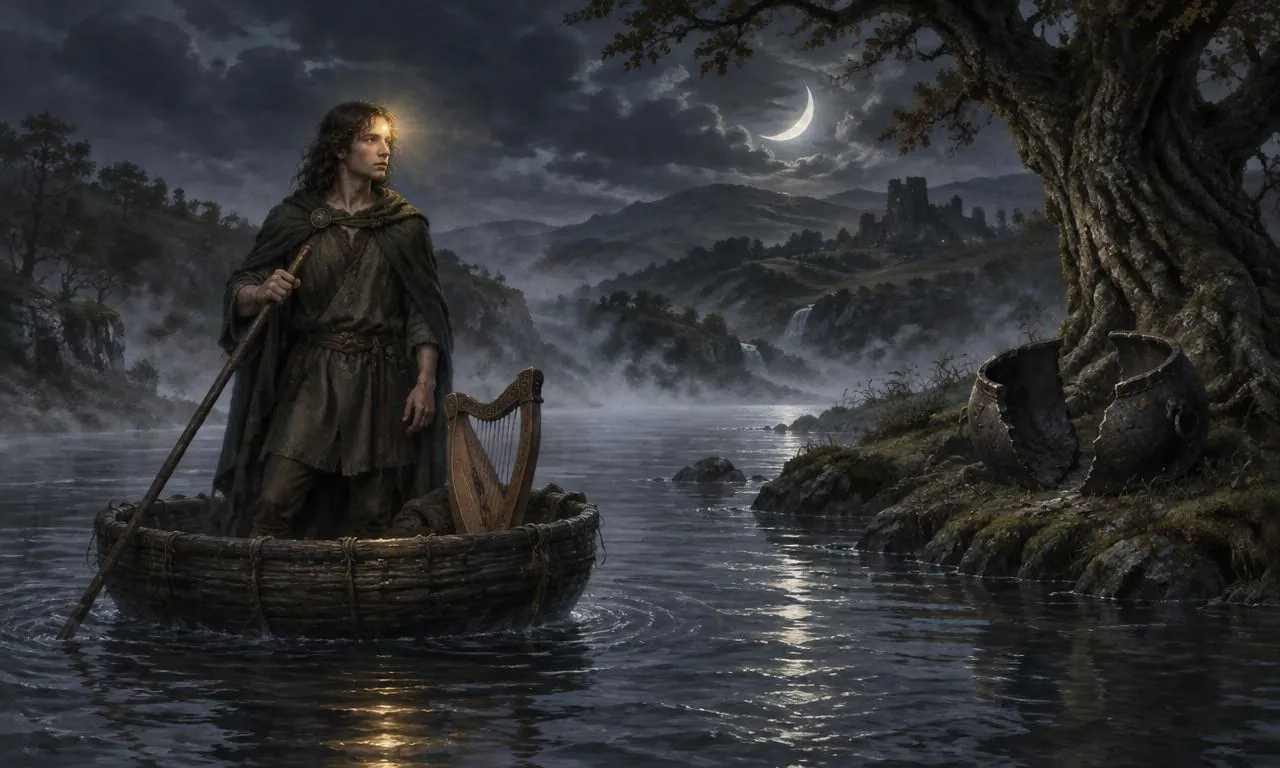
Before he was Taliesin he was nobody at all. Gwion Bach was a boy from Llanfair Caereinion, set to stir a cauldron on the shores of Llyn Tegid for a year and a day. The cauldron belonged to Ceridwen, and the brew inside it was meant for her son Morfran — a boy so ill-favoured that his mother hoped wisdom might make up for his face.
Awen is the old Welsh word for it: the flowing spirit of poetry and prophecy, the breath that makes a bard more than a man with a harp. Ceridwen's brew would hold three drops of it. The rest would be poison.
On the last day, the cauldron spat. Three scalding drops landed on Gwion's thumb, and he did what anyone would do — he put his thumb in his mouth. In that moment he knew everything: what had been, what would be, and exactly how angry Ceridwen was about to become. The cauldron cracked in two, and its poisoned water ran out to the river.
So he ran. He became a hare, and she became a greyhound. He leapt into the river as a salmon, and she followed as an otter. He took to the air as a small bird, and she rose behind him as a hawk. At last, exhausted, he dropped into a threshing barn and became a single grain of wheat among thousands. Ceridwen became a black hen, scratched through the pile, and swallowed him.
That should have been the end. Instead, nine months later, she gave birth to him. The child was so beautiful that she could not bring herself to kill him, so she sewed him into a leather bag — in some tellings a hide-wrapped coracle — and gave him to the sea.
He drifted until the eve of Calan Mai, when he was caught in the salmon weir of Gwyddno Garanhir near the mouth of the Dyfi. The weir belonged that night to Elffin, Gwyddno's unlucky son, who had hoped for a fortune in fish and found only a bag. He opened it, saw the light on the baby's forehead, and said 'Tal iesin' — radiant brow. The name was for the light on the brow, not for the voice that came later. The child answered him in verse.
Taliesin grew up in Elffin's house, and when Elffin boasted too loudly at the court of Maelgwn Gwynedd and was thrown in chains for it, the boy went to Deganwy to free him. He sat in a corner and, as the king's twenty-four bards walked past, he pouted his lips and played 'blerwm, blerwm' with his finger. When they stood to perform, they could make no other sound. Then Taliesin sang — of who he was, and who he had been: with Noah in the ark, at the fall of Troy, in the court of Dôn. Elffin's chains fell open.
The poems gathered in the Book of Taliesin are older and stranger than any single man, and that is rather the point. He is the veiled bard because nobody quite sees all of him: servant, hare, salmon, grain, infant, poet, prophet. Every shape he wore is still there beneath the next.
Wear Taliesin and you wear the Welsh idea that inspiration is not earned politely. It is caught — three drops, scalding, on an unlucky thumb — and then it chases you for the rest of your life.