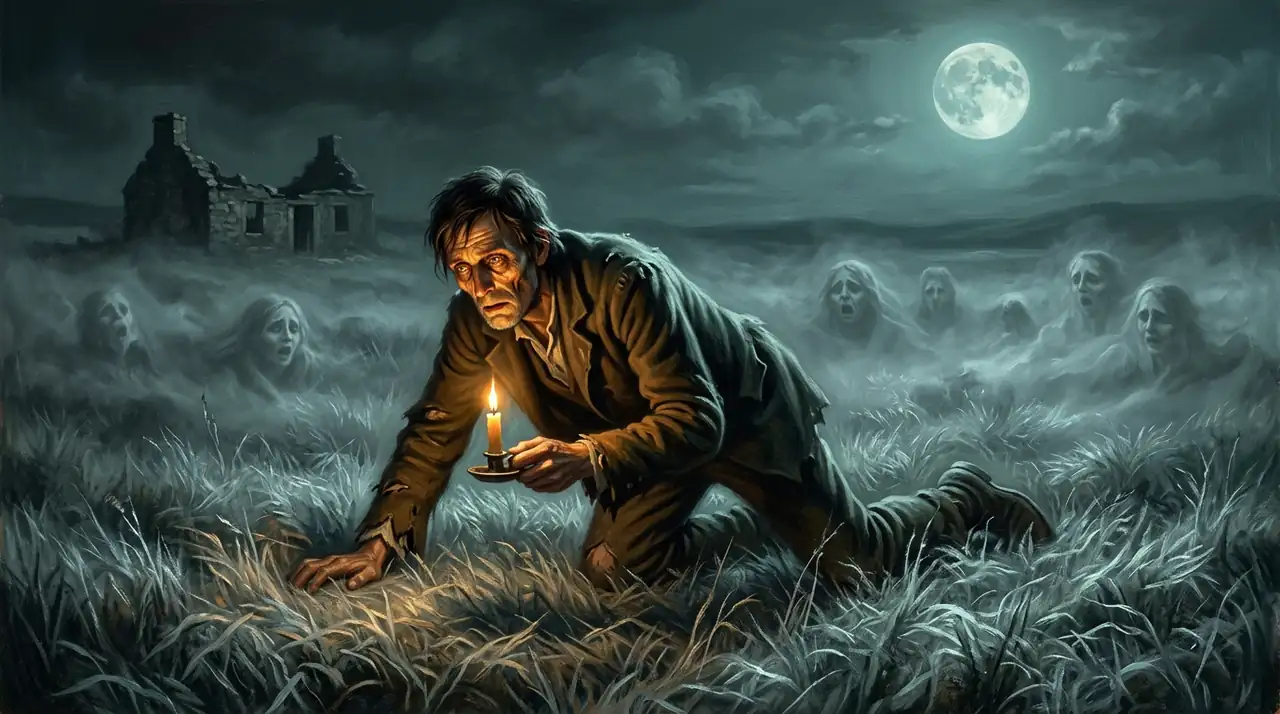
Walk far enough across the lonelier parts of rural Ireland and someone, eventually, will warn you about the Féar Gortach — the Hungry Grass. It looks no different from any other patch of meadow: pale, windblown, indistinguishable from the acres around it. But step on it, the old people say, and a sudden, savage, unaccountable hunger drops on you. Your legs go. You sink to your knees. If no one is with you to share a crust of bread, the hunger does not pass.
The belief is documented across Ireland from at least the 18th century, and probably much older. In the older versions, the Hungry Grass grows wherever the Good People — the fairies — have held a banquet and left a scrap of food behind, and to step on the spot is to be caught in the spell of their feast. In the harder Irish telling that came after, the patches were said to mark the unburied dead of An Gorta Mór — the Great Famine of 1845–1852 — where someone had collapsed and died of starvation by the roadside, and the very ground remembered it.
The cure was always the same. A traveller setting out across open country was advised to carry a piece of oaten bread or a few crumbs in a pocket. If the hunger struck, you ate the bread at once. The spell broke, your strength returned, and you could rise and walk on. To go out empty-handed across strange ground was reckless — and in famine country, it was tempting fate.
Folklorists have long noted the Féar Gortach for what it really is: a piece of national trauma turned into landscape. A million people died in the Famine. Another two million emigrated. Whole townlands were emptied within a decade. The land kept the memory of it the way only land can — in stories told to children about which fields not to cross, and in the simple, life-saving habit of never leaving the house without a bit of bread in your pocket.
Wear the Hungry Grass and you wear one of the truest pieces of Irish folklore: the meadow that remembers, and the small kindness — a shared crust — that breaks the spell.