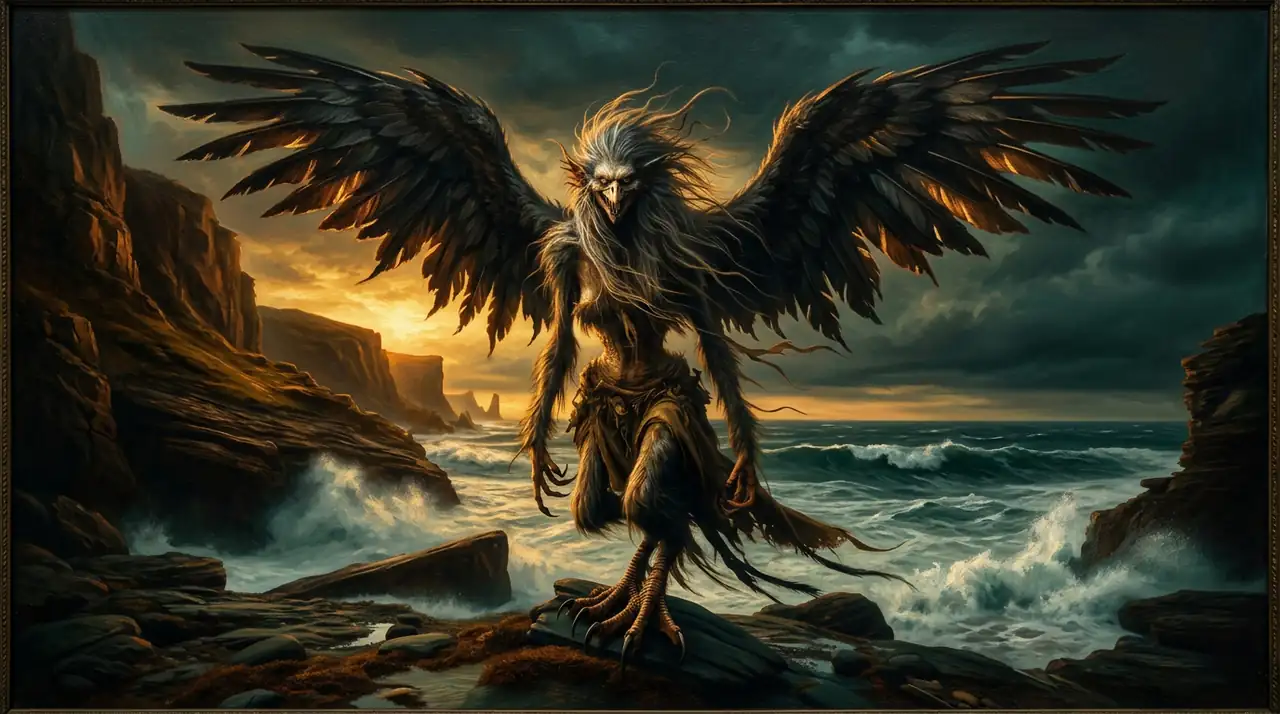
In the oldest layer of Greek myth, before the Harpies were monsters, they were weather. Hesiod calls them the daughters of the sea-god Thaumas and the cloud-nymph Electra, and gives them the names Aello (Storm-Swift) and Ocypete (Swift-Wing). Later poets added a third sister, Celaeno (the Dark One). Together they were the personification of sudden gusting winds — the kind that snatch a hat from your head, or a child from a clifftop, and never give them back.
Homer uses them exactly that way in the Odyssey. When a person vanishes without trace, the Greeks say 'the Harpies have taken them' — meaning the wind has, and no one will ever find the body. They are not yet quite the grotesque half-bird half-woman creatures of later myth. They are weather with a name.
It is in the story of Jason and the Argonauts that the Harpies become properly monstrous. The Argonauts arrive at the court of the blind seer-king Phineus, who has been cursed by Zeus for revealing too much of the future. His punishment is exquisitely cruel: every time food is set before him, the Harpies swoop down, snatch most of it away, and foul what remains so that he cannot eat. He is starving to death in plain sight of his own table.
Two of Jason's crew, the winged Boreads — sons of the north wind Boreas — fly up after the Harpies and chase them across the sky, swords drawn. The Harpies are spared only when the goddess Iris intervenes, promising on the river Styx that they will trouble Phineus no more. They retreat to a cave on Crete, the Argonauts feast the grateful king, and Phineus repays them with the prophecies they need to navigate the Clashing Rocks.
By the Roman period, in Virgil's Aeneid, the Harpies have become unambiguous monsters — bird bodies, women's faces twisted with hunger, talons that rip and foul everything they touch. Aeneas and his men land on the Strophades islands and try to feast on stolen cattle, only for the Harpies to descend and ruin the meal exactly as they ruined Phineus's. Celaeno screeches a curse from a high rock and the Trojans flee.
The Harpy is one of the great Greek inventions because she is so honest about what she is: hunger with wings. Wear her and you wear the storm-wind made flesh — beautiful, terrible, and impossible to keep hold of.