When something today is described as 'a chimera', we usually mean a fantasy, a wild and unrealistic mixture. The word comes directly from one of the strangest creatures in Greek mythology — and it earned that meaning honestly.
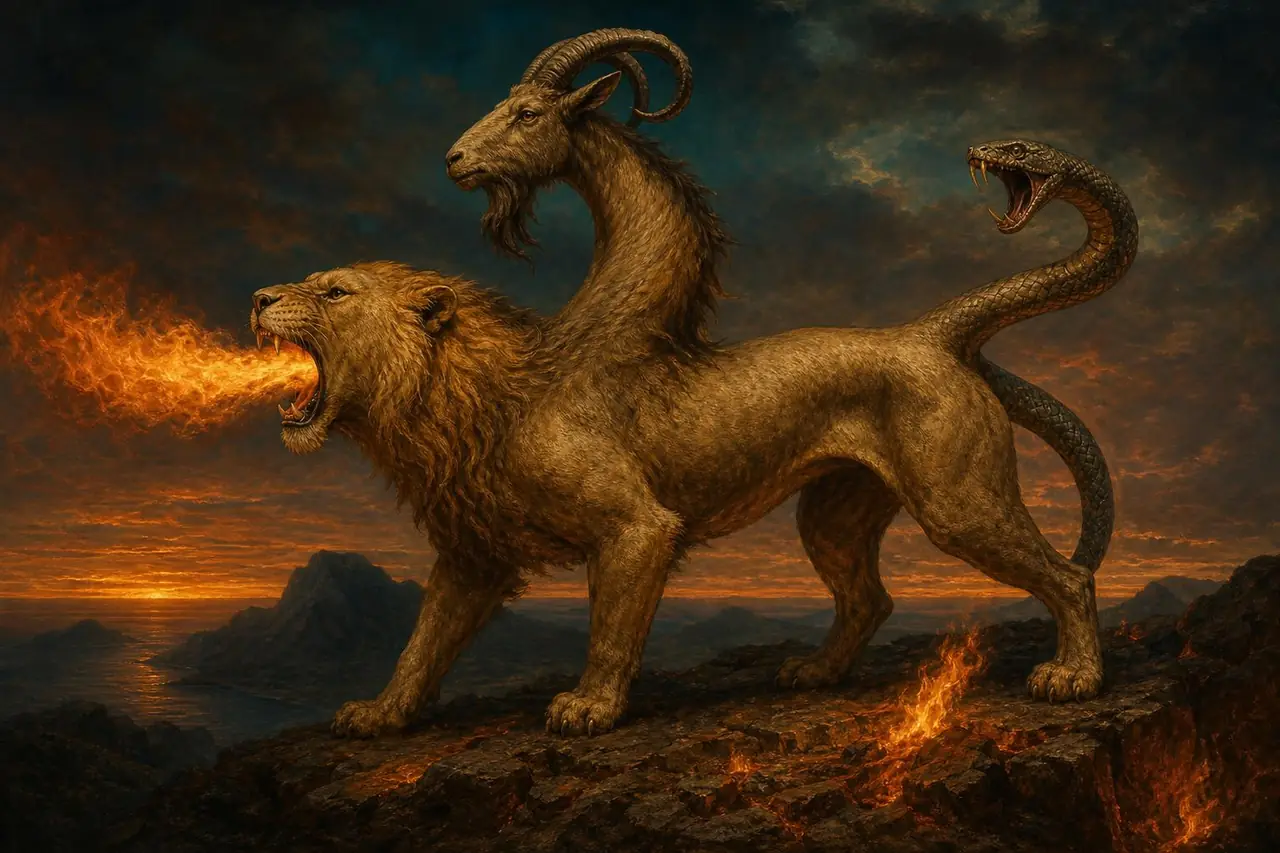
Homer described her in the Iliad in a single brutal line: 'a thing of immortal make, not human, lion-fronted and snake behind, a goat in the middle, and snorting out the breath of the terrible flame of bright fire.' Three creatures fused into one impossible body, and a mouth full of fire to make the picture even worse.
She was, like Cerberus, a child of Echidna and Typhon — making her sister to the Hydra, the Sphinx, and the Nemean Lion. Her hunting ground was Lycia, in what is now southern Turkey, where she terrorised the countryside, burning villages, killing livestock, and making the region effectively ungovernable.
The hero sent to deal with her was Bellerophon, riding the winged horse Pegasus. He had been set the task by King Iobates as a death sentence — no one expected anyone to survive a Chimera. But Bellerophon was clever. Approaching from the air on Pegasus, well out of reach of her flames, he attached a lump of lead to the tip of his spear and drove it down her throat as she opened her mouth to roast him. Her own fire melted the lead. The molten metal poured down her gullet and killed her from the inside.
It is a wonderfully Greek solution: the monster's own weapon turned against her, the impossible beast undone by a tiny piece of metal and a thinking hero in the air above her.
Modern geologists have a beautiful footnote to this story. In the Lycian region of Turkey, near the village of Çıralı, there is a mountainside called Yanartaş where natural methane vents have burned continuously, in flames coming out of bare rock, for at least two and a half thousand years. The ancient Greeks knew that mountain. They walked past those flames. And they came home and told a story about a fire-breathing monster that lived in Lycia. Sometimes folklore is geology dressed up.
Wear the Chimera and you wear the original mash-up — the impossible body, the burning breath, and the reminder that the wildest myths often start with something completely real.