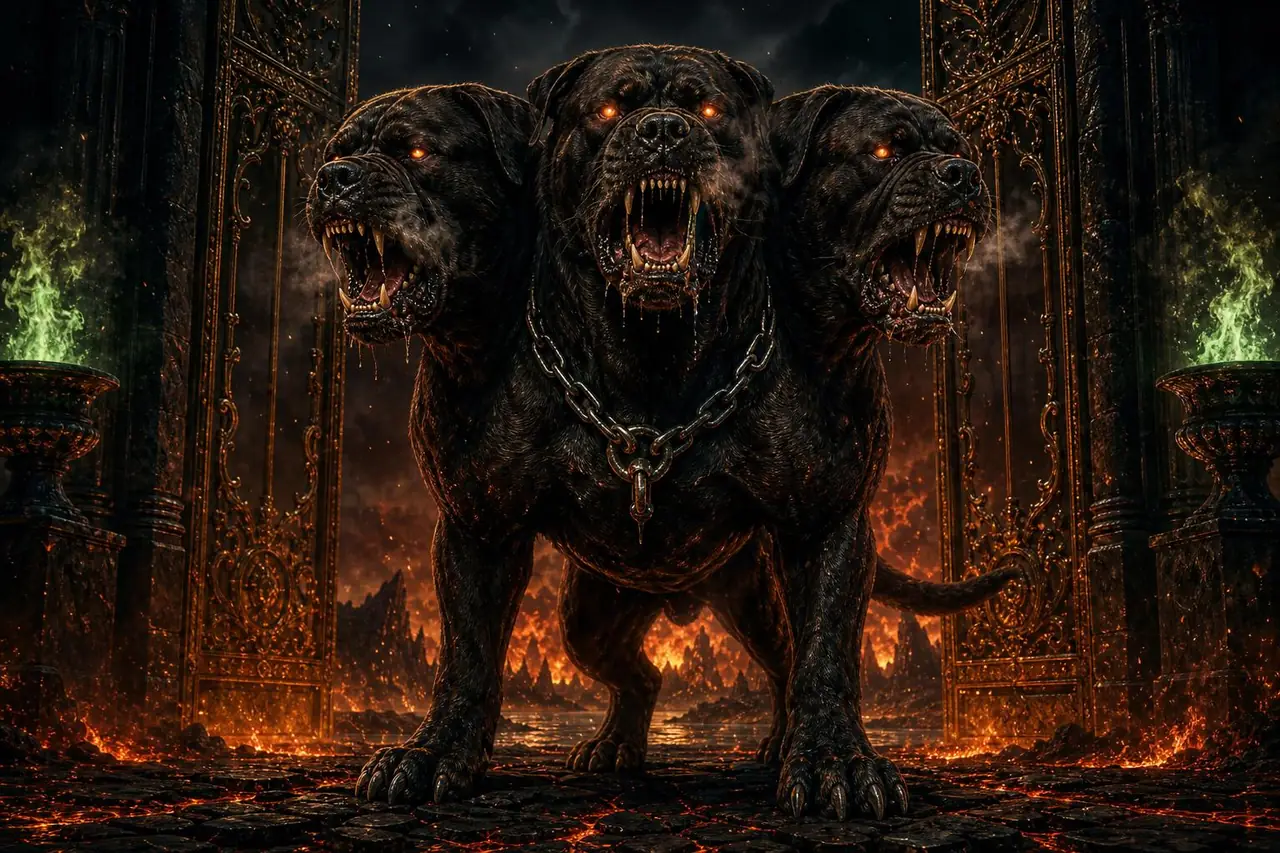
Standing at the gates of the Greek underworld, where the river Styx empties into the realm of the dead, was a job nobody really wanted. The gods gave it to a dog. A very specific dog.
Cerberus was the offspring of two of the most monstrous beings in Greek myth — the serpent-woman Echidna and the giant Typhon, parents of half the famous monsters in the canon (the Hydra, the Chimera, the Nemean Lion, and Cerberus himself). His description varies. Hesiod gives him fifty heads. Most later sources settle on three. Almost everyone agrees he had a serpent for a tail and snakes growing along his spine, and that his bark was something no living thing should ever hear up close.
His role was simple: he let souls into the underworld, and he made absolutely sure none of them ever wandered back out. He was the original one-way door.
He met his most famous defeat at the hands of Heracles, whose twelfth and final labour was to drag Cerberus up from the underworld and present him to King Eurystheus. Hades agreed — on the condition that Heracles use no weapons. So Heracles wrestled the three-headed hound bare-handed, hauled him into the sunlight, and brought him to the terrified king, who hid in a giant jar at the sight of him. Heracles, his task complete, returned the dog politely to the underworld. Cerberus, presumably, was glad to be home.
He also has a softer side in Greek storytelling. The hero Orpheus, descending into Hades to recover his lost love Eurydice, calmed Cerberus by playing his lyre — the only known instance of the hound being soothed rather than fought. Aeneas, in Virgil's later Roman version, simply throws him a drugged honey-cake and walks past while he snores.
Cerberus is one of the great mythological inventions because he is so practical. Every culture imagines an afterlife. Greek storytellers asked the next, harder question: who keeps the dead from wandering back? Their answer was a three-headed dog, with serpents for a tail and a bark that shook the underworld. Wear him and you wear that idea — the loyal, terrible guardian standing at the only door that matters.