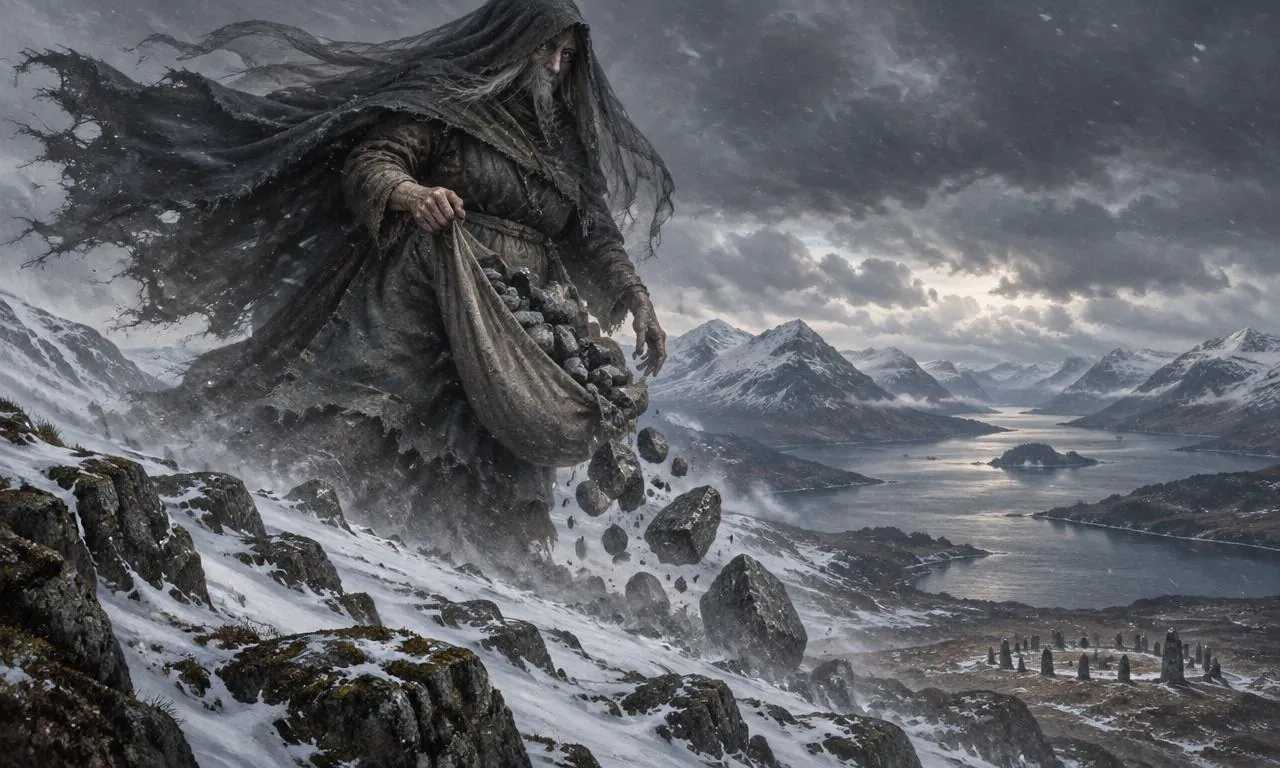
Ask the old Gaels who made the mountains of Scotland and many would have given you the same answer: an old woman did. The Cailleach — the word simply means 'the old woman' or 'the veiled one' — was the great hag of winter, and the land itself was her handiwork.
She is usually pictured as enormous, ancient and fierce, with a blue-grey face, a single piercing eye in some tellings, hair white as frost, and a great plaid wrapped around her. She strode across the Highlands carrying rocks and earth in her creel or apron, and wherever some spilled out, a hill rose. Where she stepped, lochs formed in her footprints. Ben Nevis, Ben Cruachan and a host of lesser peaks have been claimed as hers, and the scatter of boulders across a moor was simply the Cailleach being careless.
Her particular season was winter. As the year turned dark, she was said to take up her staff and strike the ground, and frost followed wherever the blow landed. One of the best-known pictures of her comes from the Gulf of Corryvreckan, the great whirlpool between Jura and Scarba. There, the tellings say, the Cailleach washed her plaid at the start of winter. The roar of the whirlpool could be heard for miles, and when she lifted the cloth out, it was white — and the whole land lay under snow.
But winter cannot last forever, and neither can her reign. In many Scottish tellings, the Cailleach holds a young goddess of summer — often called Brìde — captive through the dark months, and fights to keep her. As spring comes, the struggle turns. The old woman's power fails, and at Beltane she throws her staff under a holly bush or a gorse bush, where no grass grows, and turns to stone until the autumn comes round again. Several standing stones and rocky outcrops across the Highlands are pointed out as the Cailleach, waiting.
She is not only destructive. The Cailleach was also a guardian of wild creatures — deer especially, which she herded like cattle and milked on the hillside — and she could be a stern protector of the land against those who took too much from it. In Glen Lyon, a little stone house called Tigh nam Bodach is said to shelter a family of stones representing her and her kin, brought out into the open each summer and tucked away again for winter by the local keepers, in a tradition that has lasted a very long time.
She is not Scotland's alone. The Cailleach appears in Ireland, where the Hag of Beara is one of her great forms, and on the Isle of Man, where she is sometimes glimpsed as a huge bird on St Bride's Day. In each place she is the same deep figure: age, weather, stone, and the long dark of the year.
Wear the Cailleach and you wear the oldest power in the Highlands — the one that built the mountains before anyone thought to name them.