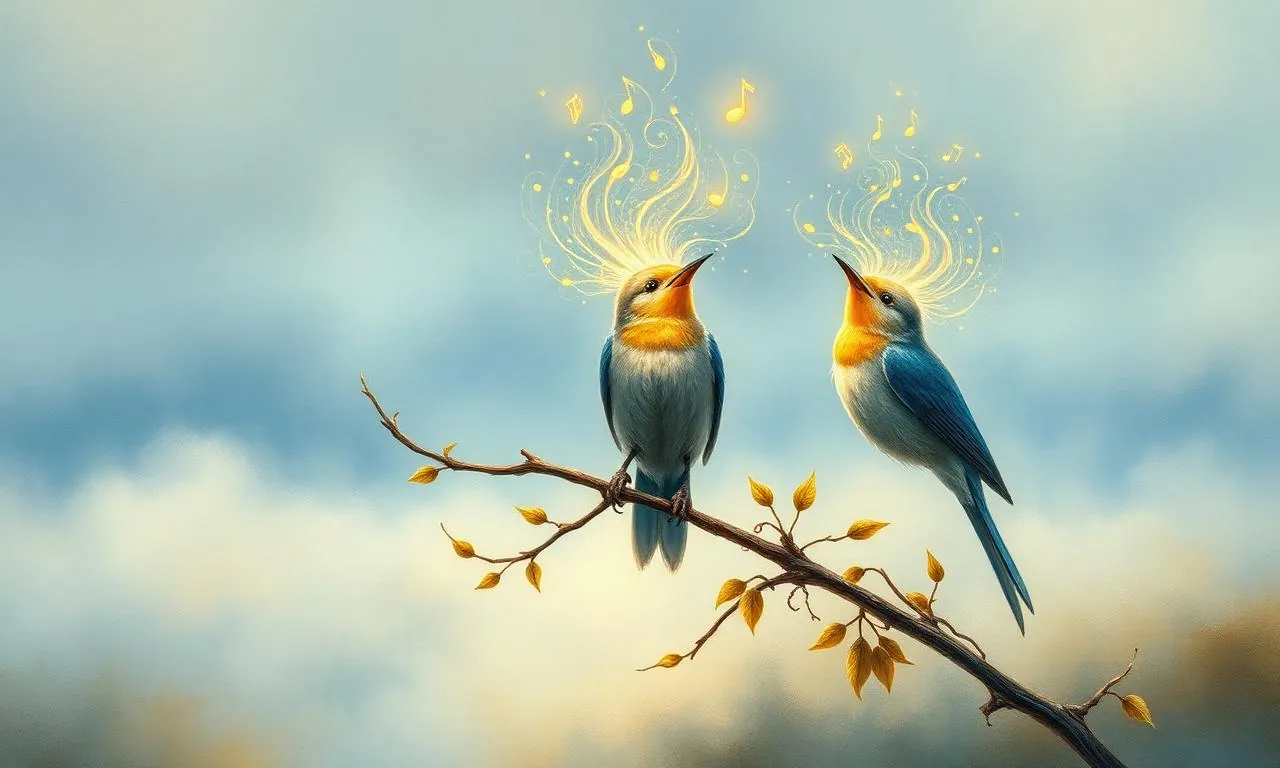
Adar Rhiannon — the Birds of Rhiannon — are a triad: three magical birds belonging to the otherworld queen of the First Branch of the Mabinogi. Their song has two equal and opposite effects. It wakes the dead. And it lulls the living into a sleep that can last for years.
They appear most famously in the Second Branch of the Mabinogi, after the disastrous war with Ireland. Of the army that sailed to rescue Branwen, only seven men return, carrying the severed head of Bendigeidfran (Brân the Blessed). At Brân's instruction they stop first at Harlech, on the coast of Gwynedd, to begin the long mourning. There, on the seaward terrace of the fortress, the Birds of Rhiannon come and sing to them.
The text is precise about the wonder of it. The birds 'seemed to be close at hand, though they were far out over the sea.' The seven men sit and listen for seven years. They feel no grief. They do not age. They are not hungry. The severed head of Brân speaks to them, eats with them, and is as good company as he was in life. The whole of the natural sequence of mourning, hunger, and time has been suspended by the song.
After the seven years at Harlech, they move to Gwales (probably Grassholm, off the coast of Pembrokeshire) and spend another eighty years in the same hall, in the same suspended state, until one of them opens the forbidden door that looks out towards Cornwall — and at once all the grief of the war, all the memory of the dead, falls on them at once.
The Birds of Rhiannon appear, more briefly, in the tale of Culhwch and Olwen as well: one of the impossible tasks set to Culhwch by the giant Ysbaddaden is to bring the Birds of Rhiannon to play at his wedding feast, 'they that wake the dead and lull the living to sleep.' That single phrase — they wake the dead and lull the living to sleep — is the whole of the lore in nine words.
We do not really know what the birds are. They are never described in detail. They are sometimes assumed to be a small kind of songbird; sometimes blackbirds; sometimes simply 'three birds.' The Welsh tradition is uncharacteristically restrained about them, as if it understands that the song is the whole point and the bird is almost a footnote.
Wear something inspired by Adar Rhiannon and you wear the gentlest miracle in Welsh myth — three birds whose song stops time, and who once sang to seven exhausted survivors on the wall at Harlech for so long that the war they had just lived through almost stopped being true.