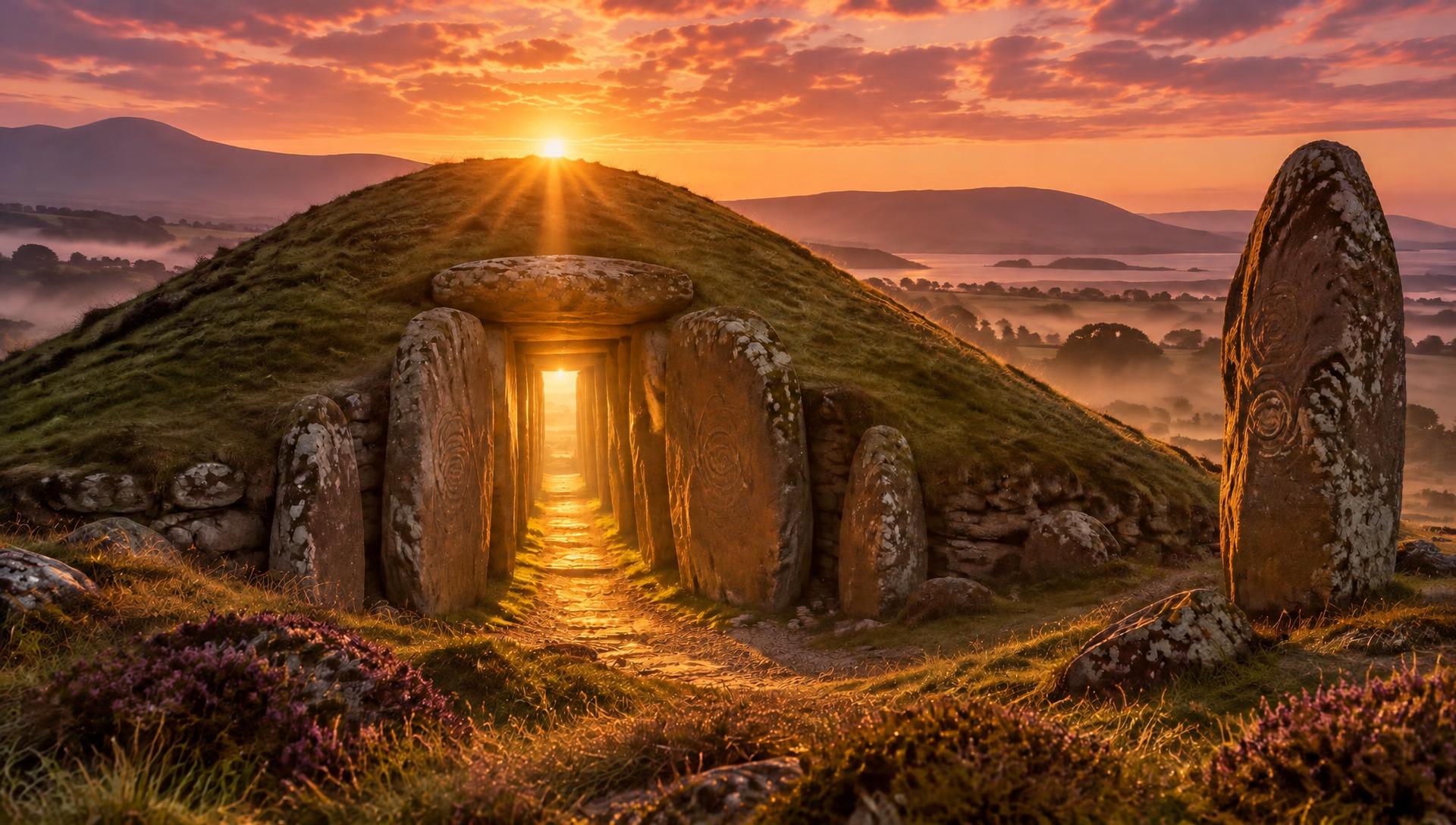
Anglesey has always carried more than its share of the old world.
The island holds one of the highest concentrations of Neolithic chambered tombs in Wales. Archaeological records list around fifty chambered tombs or clear sites of them on Ynys Môn — a density notably higher than on the nearby mainland of Gwynedd. Some of these monuments still stand and can be visited: Bryn Celli Ddu, where a shaft of midsummer sunlight still travels down the passage to the chamber; Barclodiad y Gawres, with its rare Neolithic rock art; and Lligwy, dominated by an enormous limestone capstone. Others survive only as field names or as stones that have fallen or been robbed for walls. Together they show that, more than five thousand years ago, people repeatedly chose this particular island as a place to build for their dead.
That long tradition of sacred landscape later took on a different character. By the first century AD, classical writers identified Anglesey (Mona to the Romans) as a major stronghold of the druids. In AD 60 or 61, the Roman general Suetonius Paulinus crossed the Menai Strait specifically to destroy that centre of power. Tacitus describes the druids standing on the shore with arms raised, calling down curses, while women dressed in black moved among them with torches. The legions hesitated, then crossed and burned the sacred groves. The account is brief, but it fixed Ynys Môn in memory as a sacred island — a reputation that has never entirely left it.
Welsh tradition later gave the island the epithet Môn mam Cymru — Mother of Wales. The name sits comfortably beside both the archaeology and the local folklore. The same landscape that holds the densest cluster of ancient burial places is also home to stories such as Cath Palug, the monstrous cat of Môn, and the winged serpent of Penmynydd. The chambered tombs and the later tales grew in the same soil.
For a studio based on the island, that density of both monuments and stories is not background detail. It is the ground the work comes from — not as a claim of unbroken lineage, but as a recognition that Ynys Môn has always been a place where stone and story sit unusually close together.