Last Updated: November 7, 2026
Quick Summary
Sustainable welsh clothing production starts with fabric choice, because most of a garment's environmental cost is set before cutting begins. Organic cotton avoids synthetic pesticides but still needs plenty of water, while recycled fibres cut demand for new raw material. Small, made-to-order runs then limit waste further.
- Check the fibre content label before buying or commissioning a run.
- Ask where the cloth was dyed, not only where it was woven.
- Choose fabrics that wash well so the garment stays in use longer.
- Start with one fabric you can source reliably in small quantities.
- Check minimum order quantities against real demand before committing.
Table of Contents
- Choosing Sustainable Fabrics for Clothing
- Low-Waste Garment Production on a Small Scale
- Print-on-Demand Clothing Sustainability and How to Build a Sustainable Welsh Wardrobe
- Frequently Asked Questions
Choosing Sustainable Fabrics for Clothing
Sustainable welsh clothing production methods start with the cloth. Most of a garment's environmental cost is decided before anyone cuts a pattern. Fabric choice sets the water use, the dye load and how long the item lasts.
Organic cotton avoids synthetic pesticides, but it still needs plenty of water. Recycled fibres cut the demand for new raw material. Wool and linen are often grown or produced closer to home, which can shorten transport.
- Check the fibre content label before you buy or commission a run
- Ask where the cloth was dyed, not only where it was woven
- Choose fabrics that wash well, so the garment stays in use longer
We recommend starting with one fabric you can source reliably in small quantities. Consistency matters more than variety when you are testing a method.
The article compares common fabric choices by their environmental trade-offs, which are summarised below.
| Fabric | Key benefit | Trade-off |
|---|---|---|
| Organic cotton | Avoids synthetic pesticides | Still needs plenty of water |
| Recycled fibres | Cuts demand for new raw material | Depends on the recycled source |
| Wool and linen | Often grown or produced closer to home | Can shorten transport |
Low-Waste Garment Production on a Small Scale
Small runs suit low-waste work, and sustainable welsh clothing production benefits from it. You print only what has been ordered, so there are no unsold stock piles. A small textile workshop can keep offcuts and plan cutting layouts to reduce waste. For a compact example, see the five fit in a pocket, a limited First Edition Mythôn tin.
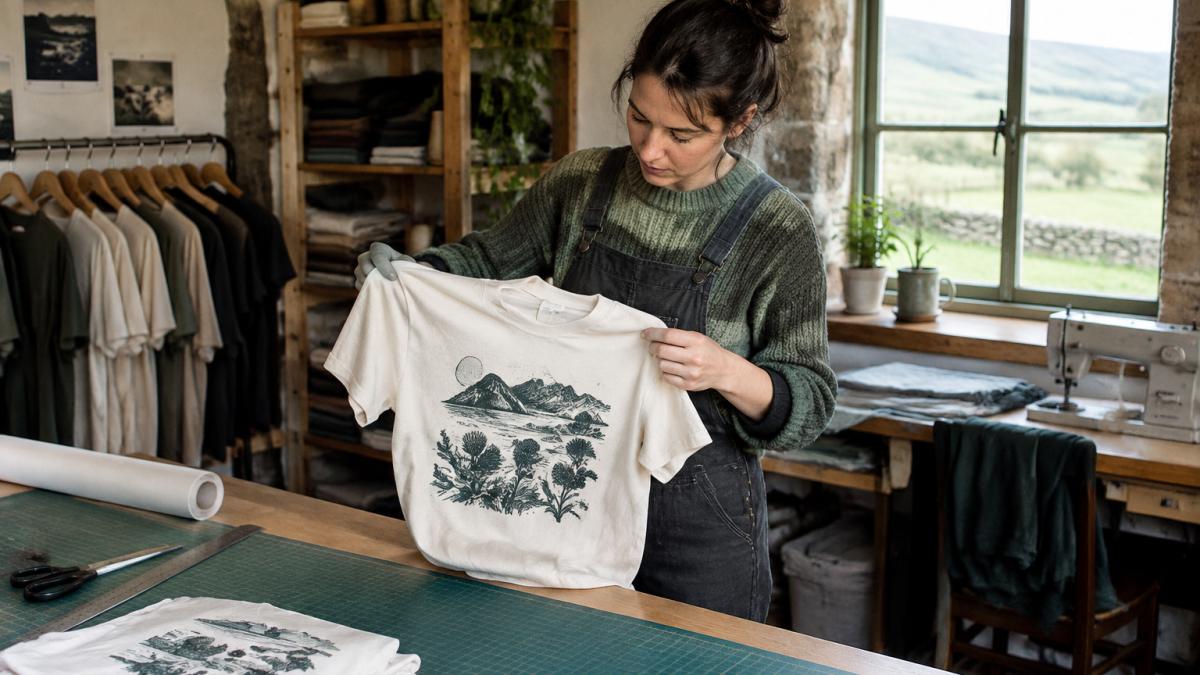
Print-on-demand follows the same logic, because each piece can be made once an order is placed.
A common mistake is overordering to get a lower unit price. Check the minimum order quantity against real demand before committing.
Print-on-Demand Clothing Sustainability and How to Build a Sustainable Welsh Wardrobe
Print-on-demand clothing reduces overproduction, but it is not automatically low-impact. The printing method, ink and garment base all matter. Ask suppliers which inks they use and whether the garments are produced to a recognised standard.
To build a sustainable Welsh wardrobe, buy fewer, better pieces and keep them in use. Made-to-order clothing is one example of buying with less waste. You can order a made-to-order piece such as a Llun Hud Artwork Black T-shirt printed from your own artwork.
Our advice is simple: buy what you will wear for years, repair what you can, and pass on what you no longer need.
Frequently Asked Questions
What makes clothing production sustainable?
Clothing production is more sustainable when it uses fibres with lower environmental impact, wastes less material, and only makes what has been ordered. Key practices include choosing organic or recycled fabrics, cutting patterns to reduce offcuts, using water-based or low-impact inks, and producing in small batches or on demand. Ask any producer for evidence of these choices, such as material certificates or a description of how orders are fulfilled, rather than relying on general claims.
Is locally made clothing always more sustainable?
Not automatically. Local production can cut transport emissions and make supply chains easier to trace, but energy use, dye processes and material sourcing matter just as much. A garment made locally from conventional cotton may have a larger footprint than one made further away from certified organic fabric. Check the materials and processes, not just the postcode, before assuming a Welsh-made item is the lower-impact choice.
How can I tell whether a Welsh clothing brand is sustainable?
Look for specifics: which fabrics are used and whether they are certified, how much stock is produced in advance, what happens to offcuts and unsold items, and where printing takes place. Brands that explain these points clearly, and say where their claims cannot yet be verified, are generally more trustworthy than those that rely on vague words like eco-friendly. Asking a brand direct questions about materials and production is a practical test.
 Add monsublimeink.uk as a preferred source on Google →